
Introduction
Few people talk openly about the emotional journey of writing a PhD thesis in India. Much of the focus remains on formatting, research design, and citations—but what often goes unspoken is how deeply personal, and at times overwhelming, this process can feel.
The long nights, the invisible pressure, the self-doubt, the silence of working alone—it adds up. For many Indian scholars, especially those balancing family expectations, jobs, or health issues, the thesis is not just an academic project. It becomes a test of resilience.
This blog explores the emotional side of thesis writing—not as a distraction from research, but as a critical part of it.
Acknowledging the inner process can help Indian scholars navigate their doubts, manage their stress, and better understand the breakthroughs that often come after quiet struggle.
When the Struggle Is Not Just Academic
Writing a thesis often begins with enthusiasm, but it doesn’t take long before the emotional weight sets in. After the initial coursework and proposal phase, many scholars find themselves working in isolation.
Especially in private universities, where doctoral programs are often flexible and designed for working professionals, the freedom to write at your own pace can become a double-edged sword.
Without regular supervision or peer discussion, scholars may feel lost—even if the research idea is strong.
Indian PhD students often come from deeply interconnected family environments. Whether you are a mid-career professional returning to study, or a younger scholar managing home expectations, the thesis timeline rarely matches the personal timeline.
Relatives ask, “Abhitak complete nahihua?” Colleagues wonder if your degree is even valid. These comments, however casual, trigger stress and a sense of inadequacy.
Then comes the guilt of slow progress. Scholars may miss deadlines—not because they are lazy, but because the work requires deep thinking that doesn’t happen on command.
Many students report feeling stuck not due to lack of data, but due to fear: fear of being wrong, fear of not sounding “academic enough,” or fear of disappointing their guide. These emotions are real, and they do affect productivity.
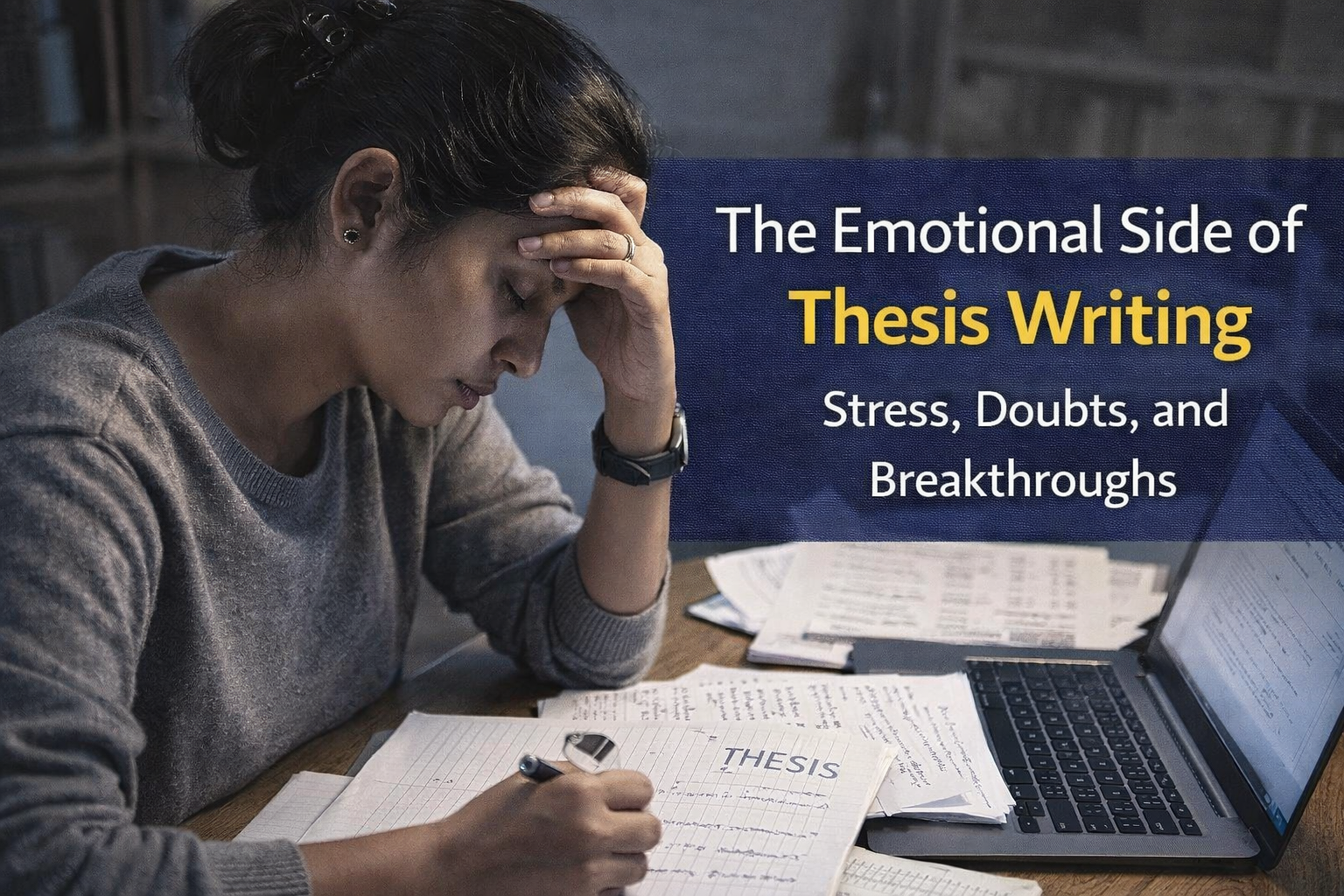
Breakdowns are more common than people admit. Some cry after a supervisor’s harsh feedback. Others quietly stop writing for weeks and can’t explain why. This is not a sign of weakness. It’s a normal part of sustained intellectual work, especially when done in isolation.
The mind begins to associate the thesis with pressure—and avoidance becomes a coping mechanism.
What makes it harder is the silence. Most scholars pretend to be “managing fine,” and no one tells you that doubt is part of the process.
In India, where academic vulnerability is rarely expressed, many scholars suffer quietly, thinking they’re the only ones who feel this way.
Recognising and Responding to Emotional Phases
Every thesis journey has emotional phases. The key is to name them, observe them, and move through them with awareness.
The early stage usually brings over-preparation—reading too much, collecting too many papers, feeling like you don’t yet know “enough” to start writing. This is often a form of fear disguised as research.
Recognising this pattern helps scholars begin drafting even before they feel fully “ready.”
The middle stage can feel like a dip. Your literature review is written, your data is collected, but the chapters feel endless.
You re-read your own writing and doubt everything. This is the point where many scholars consider quitting or taking long breaks. But breakthroughs often come after this phase—not before.
Clarity builds through consistent, imperfect work—not through waiting for confidence.
Support helps—but only if it’s the right kind. A friend who listens without giving advice. A guide who offers structured feedback instead of vague comments.
A peer who shares their own struggles honestly. These small human connections can make the emotional load lighter.
Journaling your thesis process—writing one paragraph a day about how you feel—can help release mental pressure.
It doesn’t need to be shared or academic. Just naming the emotion (“Today I feel lost with Chapter 3” or “I’m scared my data isn’t enough”) makes it easier to move forward the next day.
Another strategy is to reframe feedback. Many Indian scholars take supervisor comments personally. But critical feedback is not rejection—it’s a tool.
The goal is to make the thesis stronger. Learning to separate personal self-worth from academic writing is a major emotional shift—and a sign of real maturity in the research journey.
Breakthrough moments—when an argument clicks, or a chapter suddenly flows—often come after a long period of uncertainty. These moments are emotional too. Relief, pride, even surprise. But they are not accidents. They are the quiet rewards of staying with the discomfort, of choosing to return to the work even after difficult days.
Conclusion
Writing a thesis is as much an emotional journey as it is an intellectual one. For Indian PhD scholars, the path often includes self-doubt, family pressure, academic loneliness, and the quiet work of rebuilding confidence, again and again. These struggles are not distractions—they are the terrain of deep learning.
There’s strength in simply continuing. Even when unsure. Even when tired. The breakthroughs—emotional and intellectual—come slowly, but they do come. And in the end, the thesis is not just a document. It becomes a quiet record of everything you overcame, inside and out, to find your voice as a scholar.