
Introduction
Every PhD scholar reaches a point when the work feels too much. Whether it’s structuring chapters, reviewing literature, or handling feedback, the weight of academic expectations can be overwhelming. In the Indian context, where many doctoral students juggle jobs, family responsibilities, or come from non-English backgrounds, seeking external help has become increasingly common. But with this comes an important question: how do you get support without compromising the ethics of research?
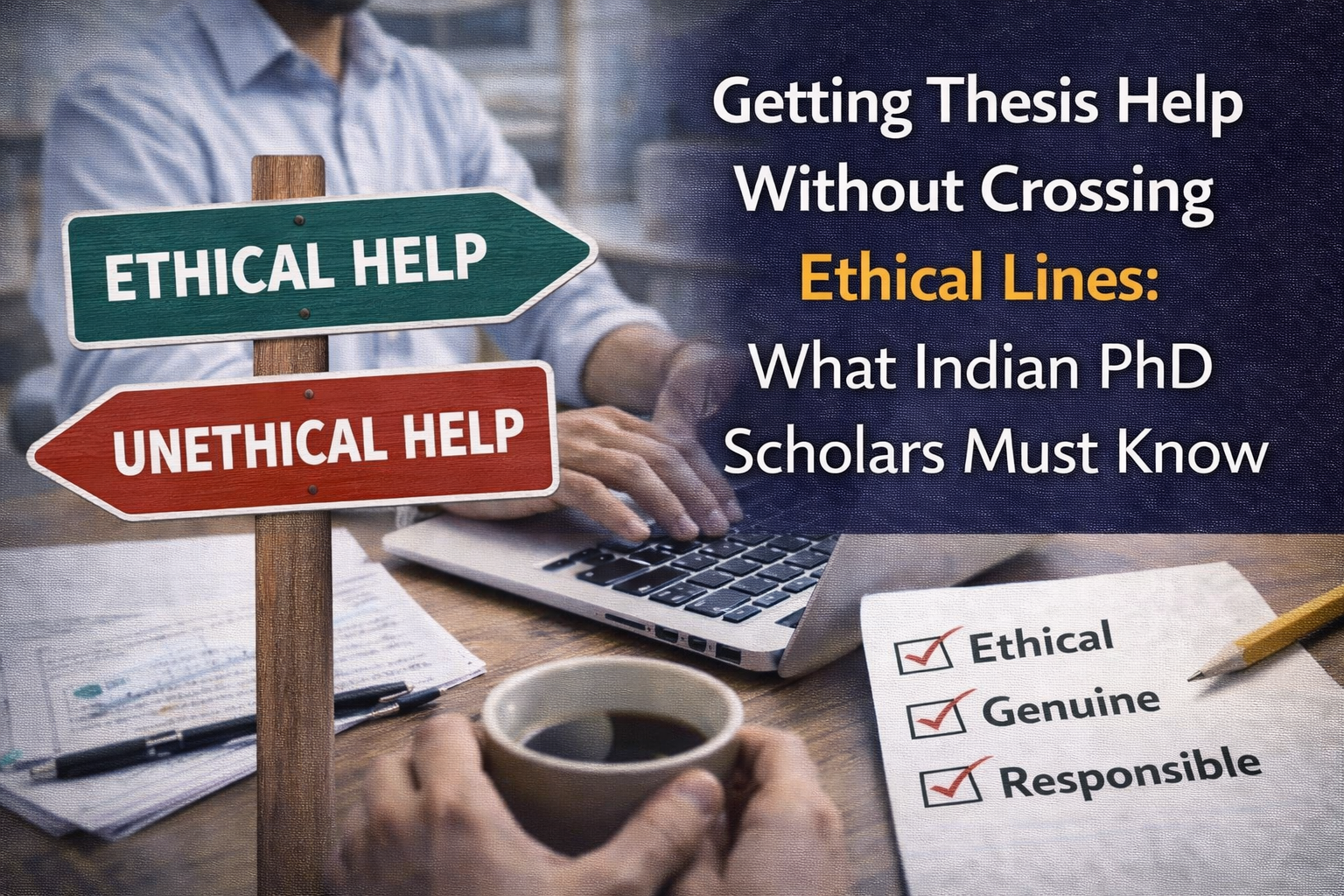
The blog titled “The Right Way to Get Help Without Crossing Ethical Lines in PhD Writing” explores the fine balance between academic support and academic dishonesty. Indian scholars—especially those in private universities—need to understand what kind of help is appropriate, and where the line must be drawn.
Where Help Is Welcome—and Where It’s Not
PhD writing is not meant to be a lonely journey. Across India, many universities now recognise the legitimacy of support in areas like language editing, formatting, and data analysis assistance. Hiring a statistician to run your SPSS tests or getting a professional to format your thesis as per university guidelines is absolutely acceptable. In fact, for many working professionals pursuing a PhD in a private university, this support is crucial to keep their progress on track.
The problem arises when the support crosses into territory where the scholar no longer owns the academic effort. For example, outsourcing the actual writing of your methodology chapter or buying a pre-written literature review violates the core principle of doctoral work—original contribution. These may seem like shortcuts, but they come with long-term academic risks.
A typical ethical scenario is this: a scholar drafts their findings and then seeks help from an academic consultant to refine the language, check citation style, or improve logical flow. This is entirely acceptable. But if the scholar hands over raw data and asks someone else to interpret it, write the analysis, and return it ready for submission, the academic line is crossed.
Universities may not always catch these distinctions immediately, but the risks are real. Rejection during viva voce, delays in approval, or worse—academic misconduct charges—can arise if the writing does not reflect the scholar’s understanding.
That said, seeking guidance is not only ethical—it is encouraged. Talking to senior scholars, discussing chapter structure with mentors, attending writing workshops, or even using thesis editing services for clarity are all valid forms of help. In fact, many private universities now recommend scholars get professional editing done before final submission, especially for language and grammar.
The line must always be drawn at intellectual contribution. If you’re not writing the ideas, connecting the theories, or explaining your data yourself, then the work is not yours. No amount of NDAs or ghostwriting promises can make that acceptable in an academic space.
Another grey area is the use of AI tools. While checking grammar or summarising notes is fine, using AI to generate entire literature reviews or write sections of your thesis without fact-checking or rewriting in your voice can easily lead to plagiarism, even if it’s unintentional. Scholars must understand that tools can support, but not substitute, the researcher’s thinking.
Ethical help also includes timely and transparent collaboration. For example, if you hire someone to help format references or check university compliance rules, make sure you understand the changes being made. Don’t submit work you haven’t reviewed or don’t fully grasp. It may pass plagiarism tools, but it might not stand up during your final defense.
There’s also an emotional angle. Many Indian scholars hesitate to ask for help because they fear judgment—from guides, peers, or family. But seeking support doesn’t make the research any less valid—it’s how you seek that support that matters. Ethical collaboration strengthens your work. Unethical shortcuts only weaken your confidence in the long run.
If you’re unsure whether a particular kind of help is acceptable, a simple question can guide you: “Would I be comfortable explaining this in front of my viva panel?” If the answer is no, it’s likely not the right kind of help.
In the current Indian PhD landscape—especially with growing digital services, academic freelancers, and consulting platforms—it’s easy to find someone willing to “handle everything.” But that’s exactly what scholars should avoid. Instead, choose services that guide, not ghost-write; refine, not replace. Look for collaborators who ask questions, challenge your ideas, and push you to write better—not ones who promise you don’t have to write at all.
Support during PhD writing is not a weakness—it’s often a necessity, especially in today’s demanding academic climate. But the right kind of help is the kind that leaves your voice at the centre of the work. Whether it’s refining your draft or helping with structure, ethical collaboration keeps your research authentic and defensible.
Conclusion
For Indian scholars striving to balance life, work, and a thesis, there are ethical ways to ease the journey. Just remember: the goal of a PhD isn’t a perfect document—it’s proof that you can think, write, and contribute as a scholar. No one else can do that for you.