
Introduction
Thesis writing is a daunting task for any PhD scholar—but how it unfolds depends heavily on your discipline. A candidate pursuing literature or philosophy will approach the process very differently from someone working in biotechnology or data science.
In India, where disciplinary boundaries often overlap with institutional expectations, understanding these distinctions becomes crucial.
Whether you’re from a private university with interdisciplinary flexibility or a state university with rigid formats, recognising the core differences between humanities and science theses can help you plan better, avoid confusion, and stay aligned with your academic goals.
“Thesis writing in humanities vs. sciences” isn’t just about format—it reflects how knowledge itself is structured and valued within Indian academia.
Discipline Shapes Method, Language, and Structure
At first glance, both types of theses follow similar formal requirements: introduction, literature review, methodology, chapters or experiments, results, discussion, and conclusion. But this structural similarity hides deeper differences in purpose, style, and process.
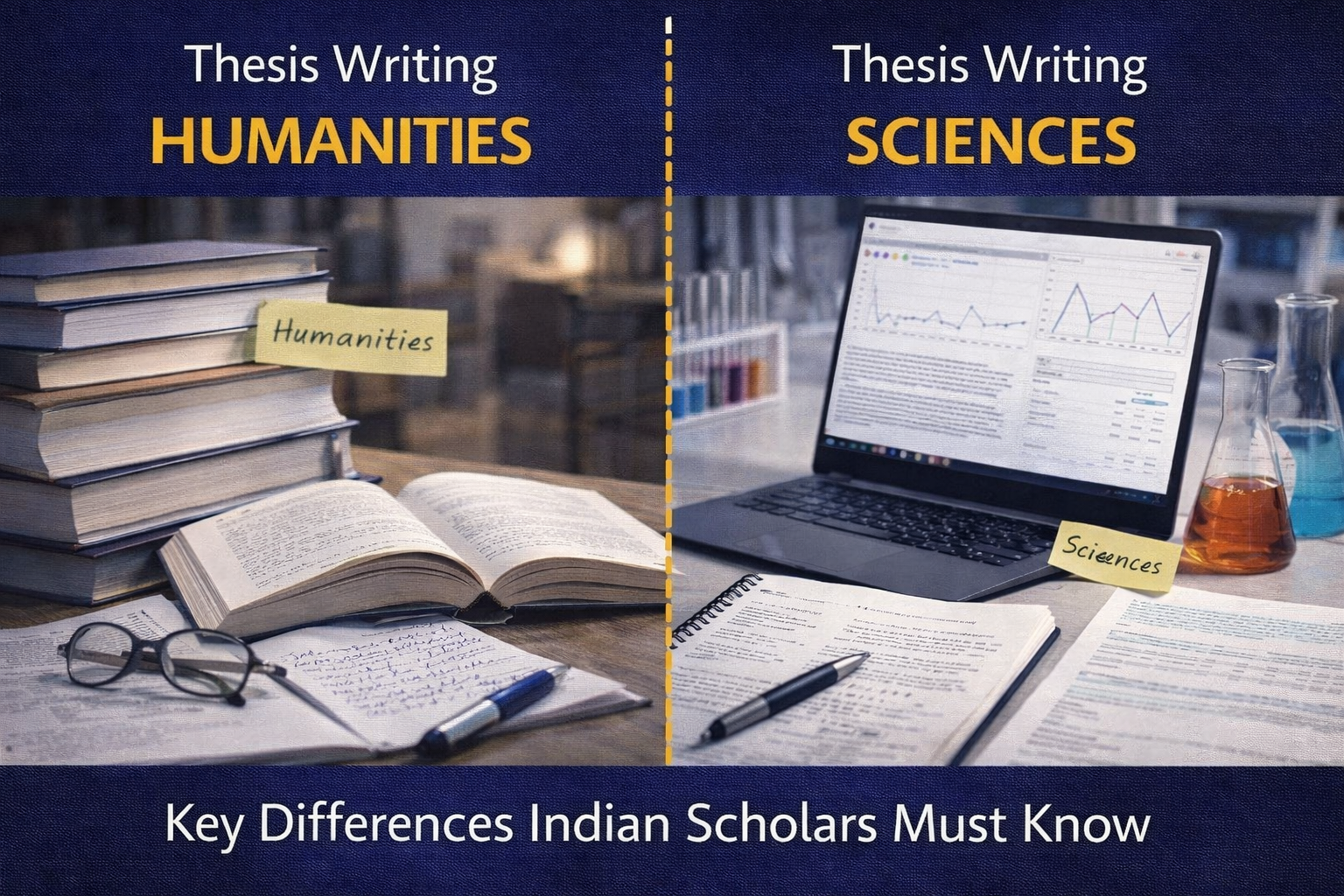
In the humanities, thesis writing is often a narrative journey. A candidate in English literature, for instance, may spend months refining a theoretical framework before even beginning the actual chapters.
The language is interpretive, often drawing from critical traditions like postcolonial theory, semiotics, or feminism. The literature review is expansive, sometimes forming the backbone of the argument.
Indian scholars in the humanities, particularly in private universities, also face pressure to connect their work with socially relevant themes—gender, caste, regional identity—which adds layers to both the writing and the review process.
In contrast, a science thesis is driven by experiments, data, and technical validation. A scholar in biotechnology, for example, must spend a significant portion of time in the lab—collecting samples, running tests, validating protocols.
The writing follows the data: methodology and results sections are central, and discussion often focuses on precision, reproducibility, and empirical grounding. The language is concise, objective, and tends to avoid interpretive speculation.
For Indian science scholars, especially those in private institutions, the emphasis is often on publishing in Scopus or UGC-CARE journals even before thesis submission—making the writing more fragmented and time-sensitive.
Another major difference lies in time management and supervision. Humanities scholars may go through long periods of solitary reading and reflection, with only periodic check-ins with their guides.
In contrast, science PhD students often work in lab groups or research clusters, where regular updates and data presentations are the norm. This changes not just how the thesis is written, but how the scholar experiences the entire PhD journey.
Then there is the matter of assessment. Humanities theses are often judged on originality of argument and engagement with theoretical perspectives.
Examiners may ask: “Does this thesis add to our understanding of a cultural, historical, or philosophical problem?” In sciences, however, the questions are different: “Are the results statistically valid?” “Can this method be reproduced?” “Is this study useful for the field?”
Where Indian Context Adds Complexity
Indian universities—particularly private and deemed institutions—have their own layered expectations that influence thesis writing across disciplines. For example, scholars in humanities are increasingly encouraged to demonstrate “interdisciplinary relevance” or “policy implications,” which wasn’t the norm a decade ago.
A history scholar might be asked to relate her work to contemporary education debates or national identity questions, even if her core research is archival.
Similarly, science scholars often navigate funding requirements, publication mandates, and intellectual property issues.
Many private universities expect science scholars to file patents or secure project-based grants before submission. This shapes how the thesis is structured—more technical appendices, formatted results tables, and sometimes even confidential data protocols.
Another subtle yet impactful difference is access to resources. Humanities scholars often depend on libraries, archives, or translations—which may be unevenly available, especially outside metro cities. Science scholars, meanwhile, depend on functioning labs, reagents, and sometimes even vendor relationships to continue their work. These real-world constraints deeply affect the pace and style of thesis writing.
Language use also differs significantly. Humanities writing in India tends to be more formal, occasionally ornate, drawing on established scholarly traditions from both Indian and Western academia.
Science writing leans towards brevity and technical clarity, with many scholars relying on tools like Grammarly or referencing software to manage the precision expected in formatting and citation.
Lastly, the role of supervisor feedbackvaries. Humanities scholars often receive open-ended, interpretive comments like “Expand on this argument” or “Explore this thinker’s relevance.” In sciences, feedback is often more specific: “Run another trial,” “Check your variable control,” or “Include error bars in your graph.” This changes not only how revisions are made, but also how students internalise academic critique.
Conclusion
Writing a thesis in India—whether in the humanities or sciences—is shaped not just by discipline but by institutional culture, supervisor expectations, and practical constraints.
While both types of scholars work toward the same goal—a doctoral degree—their journeys are fundamentally different.
Recognising these differences can help you work smarter, communicate better with your guide, and reduce the anxiety of not “matching” another scholar’s pace or style. A strong humanities thesis shows depth of thought and critical engagement.
A strong science thesis demonstrates methodological rigour and empirical contribution. Both are valid, both are demanding, and both deserve respect.
If you understand the expectations of your field—and stay honest about your process—you’ll find your way through thesis writing with more clarity and less frustration.