
Introduction
In the age of digital efficiency, many Indian PhD scholars — particularly those in private universities or balancing work and study — have started treating thesis writing like any other content task. Just as companies hire freelance writers to churn out blogs or marketing materials, students are tempted to outsource thesis chapters or use AI tools to “generate” content. The growing availability of AI writing software only deepens this mindset.
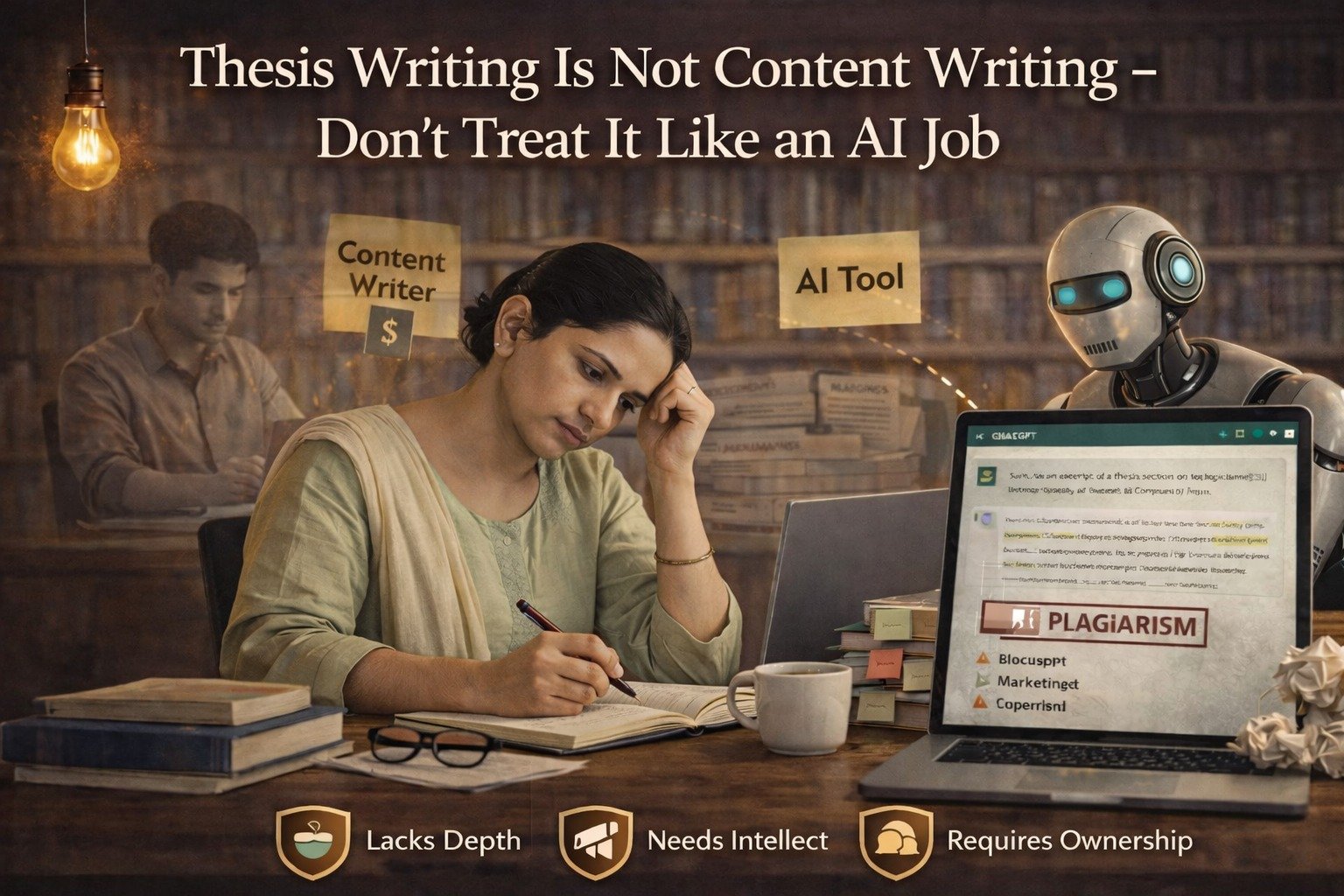
But this approach misses the fundamental nature of what a thesis is meant to be. A doctoral thesis is not a content writing project. It is an academic inquiry, a process of deep intellectual engagement that unfolds over time. Treating it like a quick assignment — or worse, expecting AI to do it — not only undermines the purpose of the research but also puts your academic credibility at risk. For Indian scholars, especially those from diverse linguistic and disciplinary backgrounds, it’s essential to understand why thesis writing demands more than content production.
Why a Thesis Is More Than Just Written Material
At first glance, a thesis and a long-form article might seem similar — both involve structured writing, references, and a flow of ideas. But the comparison stops there. A blog post or report can be written in a few days with basic research and polished language. A thesis, however, is the outcome of months (or years) of conceptual development, literature review, data collection, and analysis.
Content writing focuses on communicating information to an audience quickly and clearly. It prioritises readability, searchability, and engagement. Thesis writing, on the other hand, prioritises depth, originality, and scholarly contribution. You’re not just explaining facts — you’re making an argument, positioning yourself within academic debates, and often proposing new ways of understanding a topic.
A management scholar writing about rural entrepreneurship in Gujarat must go beyond describing trends. They must critically analyse existing models, engage with theories, gather data, and interpret the findings — all while situating their work within an academic framework. No content writer, however skilled, can do this on the scholar’s behalf. And no AI tool can understand the complexity of regional realities, policy implications, and theoretical nuance.
The Temptation of AI — and Why It’s Misleading
It’s easy to see why AI is appealing. With tools like ChatGPT or Jasper.ai offering instant paragraphs and rewording services, scholars feel they’ve found a shortcut. You input a question, and the tool responds with a coherent answer. It looks clean, sounds academic, and seems to save hours of work.
But this surface neatness hides deep flaws:
• Lack of depth: AI-generated content is based on pattern prediction, not understanding. It cannot build arguments, weigh conflicting evidence, or reflect your unique research context.
• Generic phrasing: The writing often sounds vague or impersonal, which is the opposite of what academic committees expect from a thesis.
• Inaccurate references: Many AI tools invent citations or misquote sources, leading to credibility issues.
• Inconsistent tone: AI-generated sections rarely match the scholar’s actual writing voice, which becomes obvious in oral defences or supervisor reviews.
A scholar from a private university in Noida shared how she used an AI tool to draft part of her literature review. Though the writing seemed polished, her guide noticed that key theories were misrepresented. The scholar had to revise the entire chapter — this time with a clearer focus on understanding rather than content generation.
Indian Academic Expectations Go Beyond Presentation
In India, thesis evaluation is not just about neat formatting or impressive language. Supervisors and examiners expect you to show evidence of critical engagement. They ask why a particular framework was used, how data was analysed, or what methodological choices were made. These are not content questions — they are questions of reasoning and scholarship.
Unlike blog readers, academic evaluators aren’t passive consumers of your writing. They challenge it, test its logic, and check for conceptual coherence. If your thesis feels like a patchwork of AI-generated or outsourced paragraphs, it won’t survive the review process — no matter how grammatically correct it is.
Moreover, cultural context matters. Many Indian research topics — from social inequality to local governance — require grounded understanding of language, region, and social dynamics. An AI tool or generic writer cannot engage with this complexity. Only you, as the researcher, can.
Building a Thesis Requires Your Time, Thought, and Voice
The most important reason thesis writing isn’t content writing is this: it’s your intellectual journey. Each section — from the introduction to the conclusion — reflects your choices, your growth, and your relationship with knowledge. When you write your own literature review, you don’t just summarise others — you learn how ideas connect. When you write your methodology chapter, you clarify why your approach matters.
Outsourcing this journey — or automating it — robs you of that development. You may end up with a document, but not with the skills or confidence that should come with earning a PhD.
A scholar in education from Bengaluru shared that writing his thesis slowly — despite language difficulties — gave him the courage to present at conferences and write academic papers later. He didn’t see thesis writing as a task to finish, but as training for his future academic life.
Conclusion
In a world that rewards speed and surface polish, it’s tempting to treat thesis writing like content work. But research isn’t about quick delivery — it’s about depth, reflection, and ownership. AI and content writers might help with language or structure, but they cannot replace your presence as a thinker and scholar.
A thesis is not a product to be outsourced. It is a process to be lived. And in the Indian research landscape, where the stakes are high and the journey often lonely, staying connected to your work is the most powerful thing you can do.