
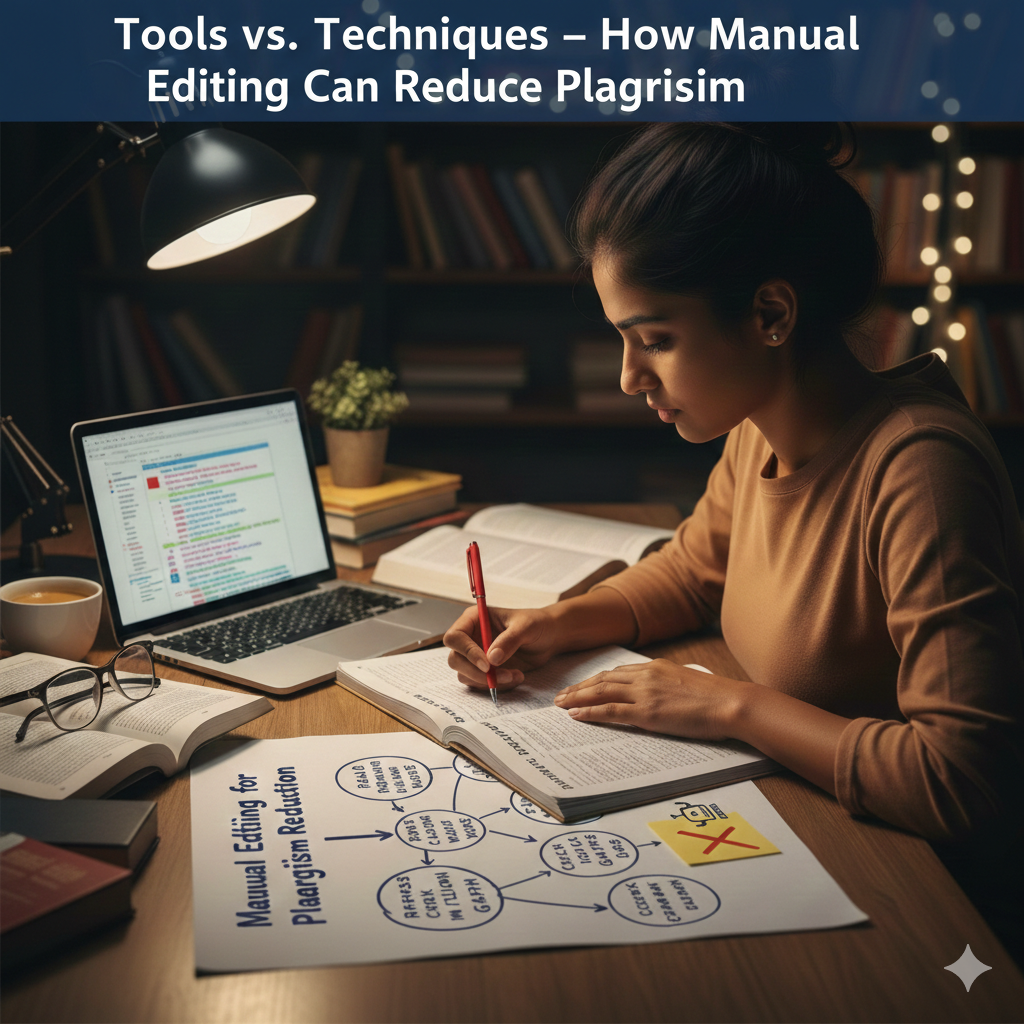
Introduction
Plagiarism detection tools have become standard across Indian universities. Whether you’re submitting your thesis at a private institution or a central university, chances are your work will go through Turnitin, Urkund, or a similar software. These tools are useful, but what many Indian PhD scholars don’t realise is that reducing plagiarism isn’t just about running reports — it’s about manual editing.
In the rush to meet deadlines, many scholars turn to paraphrasing software or grammar tools that promise quick fixes. But those shortcuts often retain structure, tone, or citations that still trigger similarity reports. The real work lies not in the tool, but in the technique — the human ability to rethink, rephrase, and restructure without losing meaning.
This blog explores why manual editing remains one of the most powerful and ethical ways to reduce plagiarism in thesis writing, especially in the Indian academic context.
Why Tools Alone Are Not Enough
Plagiarism detection tools are designed to highlight similarities, not understand context. They scan your work against a large database of published material, including academic journals, past theses, websites, and even AI-generated content. While this helps in identifying overlap, it does not distinguish between intentional copying and academic confusion.
For example, a sentence like:
“The Right to Education Act was passed in India in 2009.”
may be flagged because it exists in dozens of documents — even though it’s a factual statement. Similarly, if a student uses paraphrasing software to change:
“Globalisation has influenced regional identities in complex ways,”
into:
“The process of global integration has deeply affected how local cultures see themselves,”
the structure and idea may still be close enough to be flagged — especially if citation is missing.
This is where many Indian PhD scholars struggle. They assume that tools will “fix” their similarity problems. But unless one understands why something is considered similar — and how to reconstruct it meaningfully — tools can only take you so far.
The Power of Manual Editing in Reducing Similarity
Manual editing is not just about fixing grammar or typos. It’s about looking at your writing as a whole — structure, flow, logic, and originality. For reducing plagiarism, this involves:
1. Rephrasing with Understanding
Instead of relying on synonyms, scholars must digest the source material and then explain it in their own language. This is especially important in literature reviews, where large chunks of summarised research can easily resemble the original if not reworded thoughtfully.
Example:
Original (from a source):
“Social capital facilitates cooperation among individuals through shared norms and trust.”
Manual edit:
“When people trust one another and share common values, they’re more likely to collaborate effectively — a concept scholars often call social capital.”
This shift in voice and framing makes the sentence yours — not just technically different.
2. Breaking Structural Similarity
Similarity isn’t always about the words. If the structure of a paragraph is lifted — such as listing three effects in the same order as the source — it may still be flagged. Manual editing allows you to rearrange, integrate your perspective, and combine ideas across sources, making the paragraph unique in structure as well as content.
3. Integrating Personal Insight
Indian PhD theses often include fieldwork, interviews, or case studies. One of the best ways to reduce similarity is by including your interpretation of data. Tools can’t generate that — only you can. When your voice enters the writing, it lowers the risk of unintentional plagiarism and adds depth to your argument.
4. Correcting Citation Gaps
Manual review helps catch missing in-text citations — a common issue among Indian scholars who list references at the end but forget to place them within the chapter. If you paraphrase or quote an idea, your sentence needs a citation next to it — not just in the bibliography.
5. Tailoring Language to the Indian Context
Many paraphrasing tools are built for Western academic style. Manual editing allows you to keep your regional or cultural context intact, while still writing in good English. This is particularly useful for scholars working on Indian social issues, education policy, or vernacular research.
Why Indian Scholars Benefit Most from Manual Editing
Unlike countries where academic writing is taught from undergraduate levels, many Indian scholars enter PhD programs with minimal exposure to academic phrasing, citation tools, or plagiarism norms. Those from regional universities, rural colleges, or professional backgrounds may be strong in research but unfamiliar with academic English.
Manual editing provides an opportunity to learn — not just fix. It teaches you how to express your ideas without depending on templates or previously published phrases. Over time, it improves not just your thesis, but your ability to write research articles, proposals, and postdoctoral applications.
Private universities in India often allow flexibility in timelines, formatting, and research topics — but they’re increasingly strict about plagiarism. For scholars in these spaces, manual editing becomes a safeguard against rejections or accusations that can delay or derail the PhD journey.
Conclusion
In the world of research, where originality matters as much as accuracy, tools are only the first step. To truly reduce plagiarism — and write with academic honesty — scholars must turn to manual editing. It’s not about fixing words, but about owning your voice.
For Indian PhD students navigating language challenges, varied academic exposure, and institutional expectations, manual editing is more than a technical task. It’s an academic practice that brings clarity, confidence, and credibility to your work. And in the long run, it’s what separates a borrowed argument from a scholar’s genuine contribution.