Introduction
As the final submission deadline approaches, one concern seems to echo across every PhD guide meeting, WhatsApp scholar group, and university circular: plagiarism. Whether you’re in a central university or a private institution, no thesis is accepted today without a similarity report. Indian universities have become increasingly strict, and rightly so — academic integrity is non-negotiable.
But for many Indian PhD students, especially first-generation scholars or working professionals pursuing a doctorate part-time, accessing plagiarism detection tools can feel like a puzzle. Some universities offer limited access to software like Turnitin or Ouriginal, while others expect scholars to check their work independently. This leads to confusion: Which tools are reliable? Are free options good enough? How does one know if the checker is safe and won’t misuse the document?
This blog explores the most widely used free and paid plagiarism detection tools available to Indian PhD students, with a focus on what works in the Indian academic environment — and how to use them responsibly.
Why Plagiarism Checkers Matter in Indian PhD Submissions
Plagiarism software isn’t just about catching copy-paste cases. It helps ensure that your thesis reflects original thought, proper citation, and clear academic communication. For Indian PhD students — many of whom write in English as a second language — these tools act as a final checkpoint before a thesis is submitted for review, evaluation, or viva voce.
In Indian private universities, which often admit scholars from diverse backgrounds, the burden of checking plagiarism usually falls on the scholar. And since institutional access to top tools is inconsistent, students are left to search for external solutions. But not all plagiarism checkers are created equal. Some offer a detailed report with source links. Others give only a percentage. A few store uploaded documents — which can lead to future issues if your work gets flagged by your university due to earlier uploads.
Choosing the right tool means understanding what your university expects, what each tool can provide, and how much control you retain over your document.
How Indian Scholars Use Plagiarism Tools — A Ground-Level View
Let’s look at how Indian PhD students typically encounter plagiarism tools during their research:
In central and state universities, supervisors often insist on a Turnitin report during pre-submission. The scholar may be asked to send their final draft to the guide, who then runs it through the university’s licensed account. But the feedback is often limited — a percentage and perhaps a few highlighted sentences. Scholars may not understand what exactly triggered the match.
In private universities, many departments ask students to submit a plagiarism report along with their final thesis. Here, the student is expected to find their own solution — leading many to use external consultants or editing firms. Some scholars try free tools online, unaware that these may store their documents in public databases, causing future similarity matches when the same thesis is checked again by Turnitin or URKUND.
Others use paid services that offer Turnitin-equivalent reports for a fee. These are usually safer, but quality varies widely. Some providers give fake reports or alter the similarity score, creating a serious risk for the scholar later.
This is why knowing the difference between free, safe, and university-accepted plagiarism tools is crucial. What matters is not just the percentage — but the reputation and reliability of the tool.
Free vs. Paid Options — What Actually Works
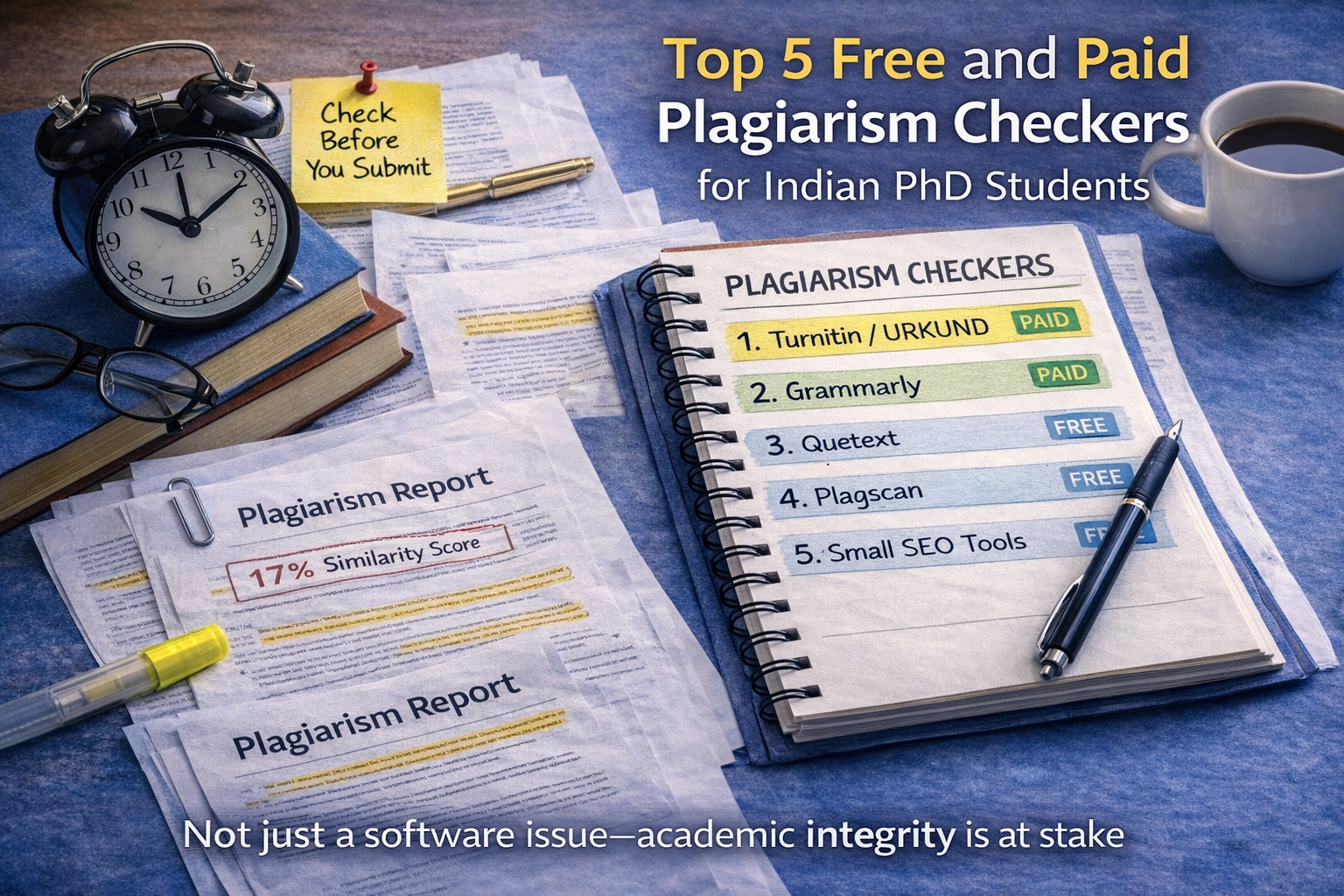
There are dozens of plagiarism checkers online, but only a few are consistently used and trusted by Indian PhD scholars. Tools like Small SEO Tools or Plagscan offer basic free checks, often with word limits and limited accuracy. These are useful if you want to test a few paragraphs — but not for checking an entire chapter or thesis.
On the other hand, tools like Grammarly Premium offer paid plagiarism checks with decent accuracy, especially for catching copied web content. However, they may not compare your writing with published journals or theses — which is what most universities want.
Then there are full academic tools like Turnitin or Ouriginal (URKUND), which are most widely accepted by Indian universities. These are rarely available directly to individual scholars, unless accessed through an institutional login or via a certified editing partner.
For this reason, some Indian scholars opt for third-party services that run your thesis through a licensed version of Turnitin. If you choose this route, it’s important to:
- Ensure the document is not stored in the tool’s database.
- Receive a detailed report with source breakdowns.
- Compare the percentage with your university’s requirement (typically below 10–15%).
Some Indian scholars also use tools like Scribbr or iThenticate, which are paid but offer detailed reports. These are often used by publishers and researchers submitting to international journals — and can be useful if you’re aiming for a thesis publication later.
Using Plagiarism Reports Wisely — Not Just for Compliance
The value of a plagiarism tool isn’t just in the number it shows. It’s in what it reveals about your writing habits, your citation consistency, and your use of source material.
Many Indian PhD scholars think that once the percentage is low, their work is safe. But what if the copied parts are in the introduction, discussion, or conclusion — the very sections examiners read most carefully? Similarly, some scholars reduce similarity by deleting citations or replacing quoted material with vague summaries — which weakens the quality of the thesis.
A plagiarism checker should be used not just to meet a requirement, but to strengthen your academic integrity. Before final submission:
- Review the report carefully.
- Fix weak paraphrasing and uncited references.
- Avoid relying on software alone — your understanding of the source matters more.
Conclusion
Plagiarism tools are no longer optional in Indian doctoral research. They’re part of the academic process — and a safeguard for both scholars and institutions. But with the rise of free websites, AI-generated content, and shortcut services, choosing the right plagiarism checker has become a decision that requires care.
Whether you use a university tool, a paid service, or a basic free option, the real check lies in how honestly you’ve written your work. A good report helps you fix issues before they become problems. But no tool can replace your responsibility as a scholar.
In the end, a clean plagiarism report is not just a formality. It’s a sign that your thesis truly reflects your thinking — and that you’ve done the work with clarity, care, and respect for the academic journey.