
Introduction
For Indian PhD scholars navigating a complex academic journey, thesis writing agencies often seem like a lifeline — especially when university support is limited, supervisors are unresponsive, or personal circumstances make independent progress difficult. In private universities, where flexibility often comes with limited mentoring, students may look for external help to ensure they stay on track.
But choosing a thesis agency is not just about finding someone who can “write well.” It’s about aligning with an ethical, academically responsible service that respects your work, your identity, and your goals. Too many scholars fall into the trap of flashy promises, aggressive marketing, or low-cost temptations — only to find themselves with plagiarised content, poor writing, or worse, an academic warning.
Before you sign up with any thesis writing agency, it’s essential to ask the right questions — not just about pricing, but about how they operate. These questions can protect your academic reputation, your thesis quality, and your peace of mind.
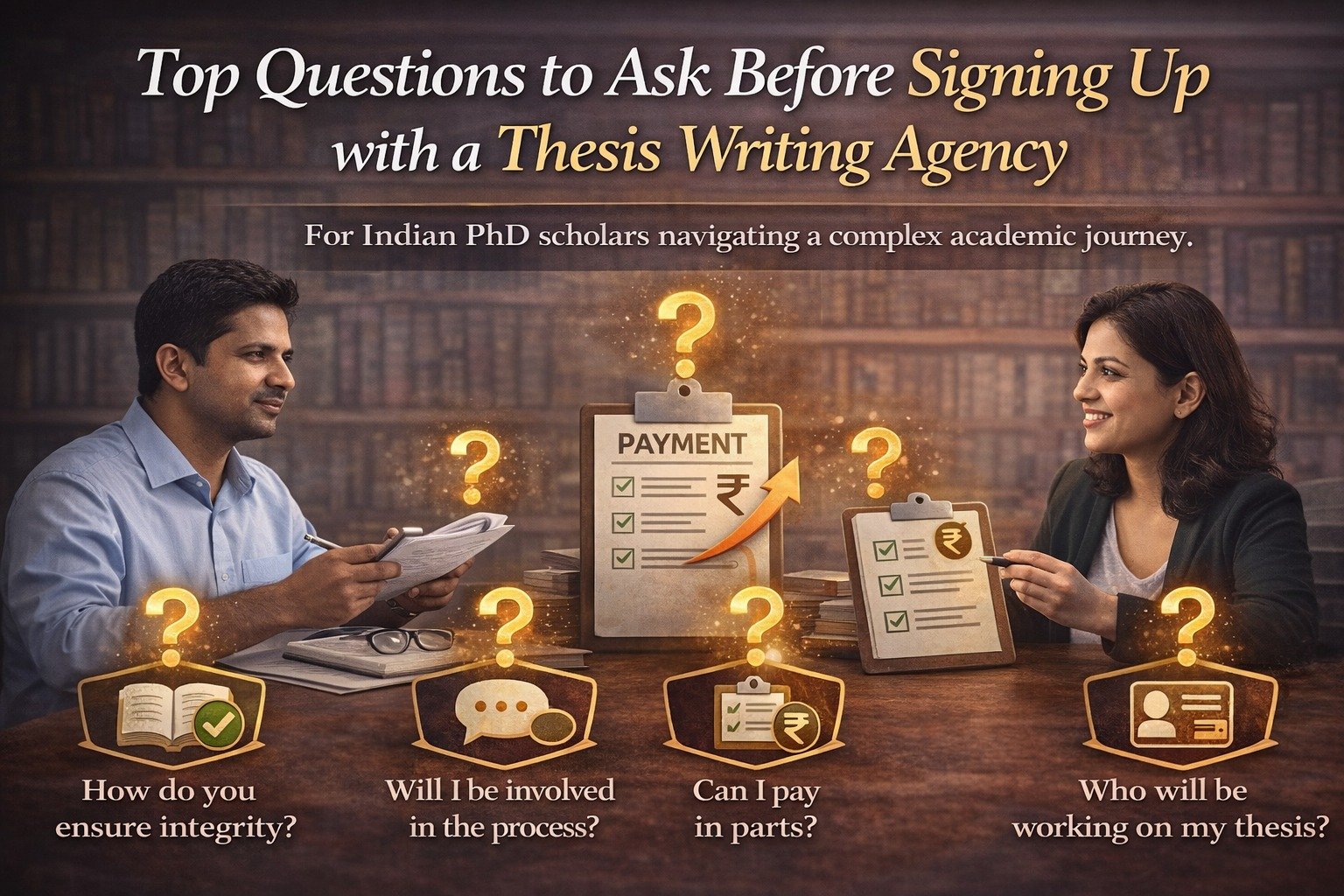
How Do You Ensure Academic Integrity?
This should be your first and most important question. Any agency that rushes past it, or gives vague answers like “Don’t worry, we’re professionals,” should be approached with caution. You need clarity on how they handle plagiarism, citation standards, and originality.
A reputable agency will explain that they do not fabricate data, copy from existing theses, or sell one template to multiple scholars. They may even offer plagiarism reports from tools like Turnitin or authenticate that the work is developed from scratch based on your inputs.
A PhD candidate in political science from Delhi recalled how a cheap service gave her a literature review filled with copy-pasted lines from websites. She was lucky her supervisor flagged it early. Not every scholar gets that second chance. Asking about integrity upfront is non-negotiable.
Will I Be Involved in the Process?
Many Indian scholars mistakenly assume they can “outsource the whole thing.” But responsible agencies do not support this model. Instead, they expect you to be involved — by sharing your research interest, reviewing drafts, giving feedback, or participating in clarifying calls.
Ask how involved you are expected to be. Will you be consulted before chapters are written? Can you discuss doubts or edits directly with a subject expert? Do they help you understand your own thesis content for viva or progress reports?
The answer to this question will reveal whether the agency sees you as a researcher — or just a paying customer. A thesis built without your involvement is not only academically risky, but also leaves you underprepared during viva voce or reviews.
What Kind of Support Do You Provide — Writing, Editing, or Coaching?
Not all support is the same. Some agencies offer writing assistance, others provide editing or polishing services, and some provide thesis coaching. You must ask what exactly they offer — and what they don’t.
For instance, if you already have a draft and just need language support, there’s no point paying for full writing. On the other hand, if you need guidance on research design or argument structure, editing alone won’t help. Ask them to define their scope clearly.
A commerce scholar in Pune shared how he paid for full writing but received only a cleaned-up version of his own rough draft. The miscommunication could have been avoided if both sides had clearly discussed the level of service.
Can I Pay in Parts? What Is the Payment Schedule?
Thesis services can be expensive, and many Indian scholars prefer to pay in instalments — especially those self-funding their research. Asking about payment flexibility isn’t rude; it’s responsible.
But go one step further: ask how payments are linked to work delivery. Is there a chapter-wise model? What happens if you’re unhappy with the first chapter? Will they revise without charging again?
Avoid agencies that demand full payment upfront without offering any trial or refund clauses. Responsible services will link progress with payment, allowing you to exit if the quality doesn’t meet expectations.
How Do You Handle Confidentiality
This is especially important in India, where scholars often don’t want their university, peers, or even their guide to know they’ve sought help. Ask how your documents are stored, who has access, and whether your details will be shared with other clients.
An honest agency will have clear policies on data handling and will never use your draft, title, or topic as a “sample” for other clients. They will also delete files after project completion, or retain them only with your consent.
Never assume confidentiality — confirm it.
Who Will Be Working on My Thesis?
Many agencies have a front-facing manager who communicates with clients, while the actual writing is outsourced to freelancers — sometimes even outside India. You have a right to ask who will be working on your thesis, and what their qualifications are.
Ideally, the subject expert should have a research background in your domain — at least a postgraduate degree, if not a PhD. If you’re in interdisciplinary fields like education and psychology, they should understand both.
A PhD candidate in Jaipur paid for thesis support in public health but later discovered her work was being handled by someone with a background in general biology — leading to poor integration of health policy frameworks. Transparency about the expert’s background matters.
Conclusion
In a research journey filled with complexity and pressure, thesis writing agencies can offer much-needed support — but only if chosen with care. Asking the right questions doesn’t make you difficult; it makes you responsible.
Whether it’s about academic integrity, payment models, confidentiality, or who’s actually writing your thesis, clarity is your best protection. In a space that’s still largely unregulated in India, a good agency won’t mind your questions — in fact, they’ll welcome them. Because at the end of the day, a real academic service isn’t just about delivering pages.It’s about helping you build a thesis you understand, stand by, and are proud to defend.