
Introduction
In Indian universities, particularly in private institutions, plagiarism detection is no longer just a student responsibility — it’s also an academic obligation for faculty. With the University Grants Commission (UGC) making plagiarism checks mandatory before thesis submission, tools like Turnitin have become essential in ensuring academic integrity. For faculty members, however, Turnitin is more than a plagiarism checker; it’s a tool that requires skill, interpretation, and ethical handling. This blog will explore what faculty members in India need to know about using Turnitin effectively, from understanding similarity reports to maintaining fairness for their students.
Why Faculty Need to Understand Turnitin Beyond the Basics
Many faculty members are introduced to Turnitin as a simple similarity checker, but its role in higher education is deeper. The tool not only compares submitted work against a vast database of academic resources, websites, and student papers, but it also helps in developing a culture of originality in classrooms. In private universities where research output is a measure of institutional reputation, faculty must ensure that the papers, theses, and publications they approve meet ethical standards. A lack of understanding of Turnitin can lead to misinterpretation of reports, unfair penalties, or missed opportunities to guide students toward genuine academic writing.
How Turnitin Works in the Indian Context
Turnitin operates by matching submitted content against billions of web pages, articles, books, and student submissions. In India, many private universities have institutional accounts that allow faculty to run similarity checks for multiple drafts before final submission. The tool produces a percentage score — the “similarity index” — which is often misunderstood as the plagiarism percentage. In reality, this score includes properly cited quotations, references, and even the bibliography. Faculty members must remember that the number itself is not the final judgment; it is the content and context of matches that matter.
Interpreting the Similarity Report Correctly
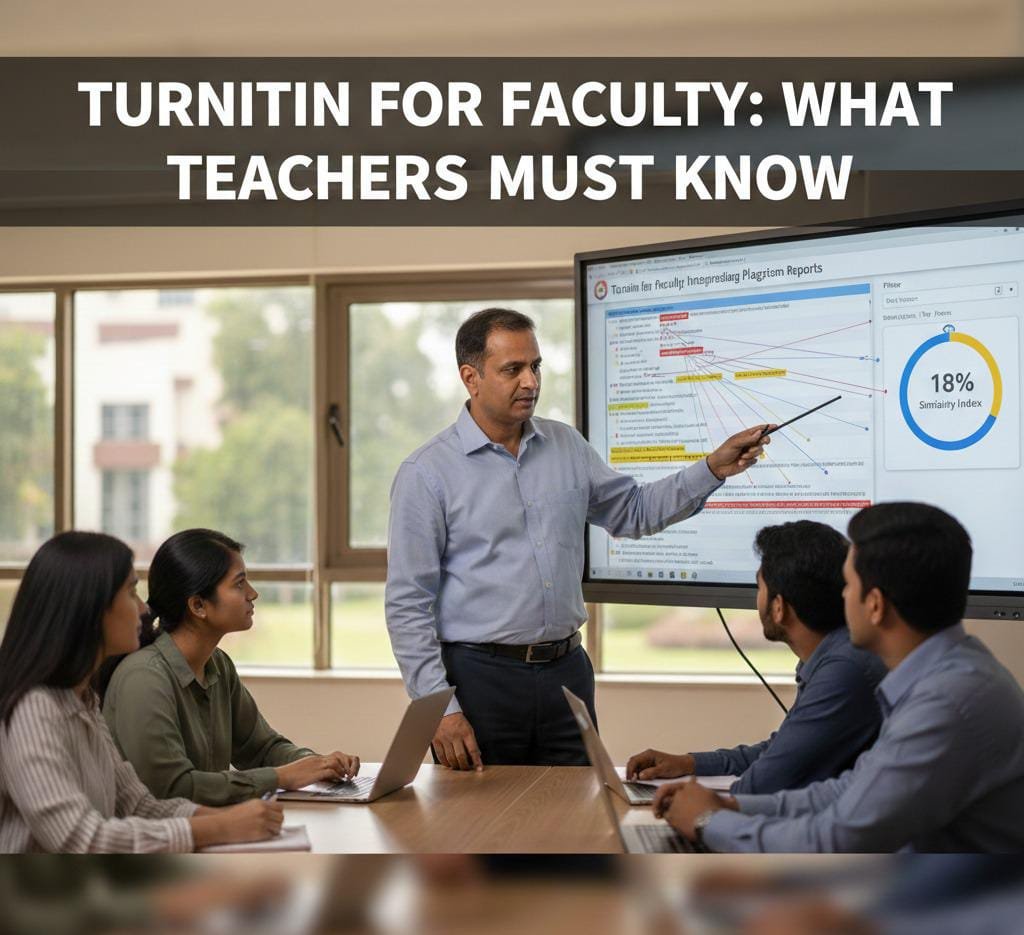
One of the most important skills for faculty is knowing how to interpret Turnitin’s similarity report. A report showing 25% similarity may still be acceptable if most of that content is from references or commonly used technical terms. On the other hand, a report showing only 10% may still have problematic matches if those sections are uncited or closely paraphrased from a single source. Faculty should focus on:
- Source Breakdown: Identify where matches are coming from — journals, books, student submissions, or the open web.
- Citation Check: Verify whether matched text has proper citations.
- Exclusion Settings: Use Turnitin’s settings to exclude bibliographies, small matches, and quoted material to get a more realistic score.
- Contextual Analysis: Judge whether the matching content reflects common academic knowledge or intentional copying.
Guiding Students Without Discouraging Them
In many Indian universities, especially in smaller private institutions, students may not be aware of plagiarism rules until their final semester. Faculty play a critical role in educating students early on. Rather than using Turnitin as a tool for punishment, teachers should introduce it as a learning aid. For example, running a draft through Turnitin and discussing the results with the student can help them improve paraphrasing, citation, and research ethics. This not only reduces plagiarism risk but also builds trust between student and teacher.
Challenges Faculty Face While Using Turnitin
Faculty members often face practical and ethical challenges when using Turnitin in India. These include:
- Technical Barriers: Not all teachers are trained to use advanced Turnitin features.
- Policy Confusion: Different universities set different acceptable similarity thresholds, sometimes leading to inconsistent decisions.
- Database Limitations: Turnitin’s database, while extensive, may not include all regional or vernacular sources, making some plagiarism harder to detect.
- Time Pressure: Faculty often have to review multiple reports in a short time, increasing the chance of oversight.
Best Practices for Faculty When Using Turnitin
To ensure Turnitin is used fairly and effectively, faculty can follow these best practices:
- Run checks on multiple drafts rather than only the final submission.
- Discuss the similarity report with students before taking disciplinary action.
- Keep departmental guidelines clear and consistent for acceptable similarity levels.
- Stay updated with UGC plagiarism regulations and institutional policies.
- Avoid over-reliance on percentage scores; focus on the nature of the matches.
Ethical Responsibilities of Faculty
Turnitin is a tool, not a final judge. The ethical responsibility lies with the faculty member to ensure that no student is wrongly penalised due to a lack of understanding of the report. Teachers should also be cautious when submitting student work to Turnitin’s repository, as this permanently stores the work in the database. In cases of resubmission or thesis revisions, faculty should check whether repository settings are appropriate to avoid false matches in future checks.
The Future of Plagiarism Detection in Indian Universities
With the rise of AI-generated content and new plagiarism techniques, Turnitin and similar tools are evolving to detect not just direct copying but also paraphrased or AI-assisted writing. Faculty will need to keep updating their skills to interpret these more complex reports. In the coming years, plagiarism detection will likely be integrated into the broader academic workflow, making it part of routine teaching rather than a separate compliance step.
Conclusion
For faculty in Indian private universities, Turnitin is far more than a software requirement — it is a critical academic tool that shapes the quality and integrity of research output. Using it effectively requires a balance of technical skill, ethical judgment, and student mentorship. When faculty see Turnitin not as a policing mechanism but as a teaching aid, they can create an academic environment where originality is valued, plagiarism is understood, and students graduate with the confidence to contribute authentically to their field.