
Introduction
When researchers run their thesis, dissertation, or paper through plagiarism detection software, the result often includes a “similarity score” along with a detailed report. One of the key elements in that report is content matching. To interpret your plagiarism report correctly—and improve your work accordingly—you must understand what content matching really means.
This blog explains the types of matches, their significance, and how to respond to them wisely in the context of Indian academic standards.
What Is Content Matching?
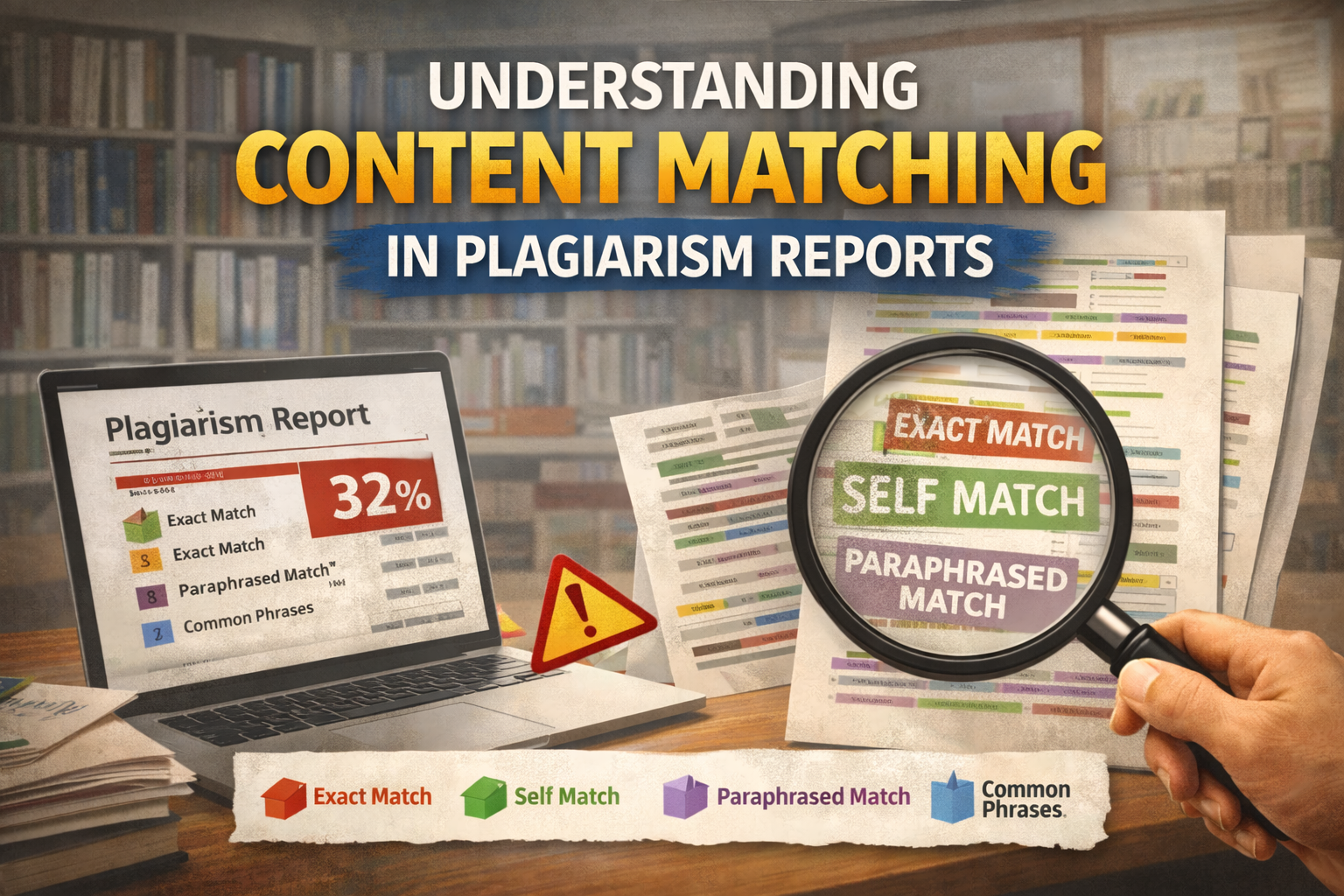
Content matching refers to portions of your submitted text that are found to be similar or identical to existing online or database content. Plagiarism software like Turnitin or Urkund highlights these matches and categorizes them based on how closely your writing resembles existing material.
However, not all matches indicate plagiarism. Understanding which matches matter is crucial.
Types of Matches Found
- Exact Matches
These are word-for-word copies from existing sources. If they are not cited or quoted properly, they are flagged as problematic. - Paraphrased Matches
Even if you’ve changed some words or sentence structure, the software may still detect similarities. Proper citation is still required for paraphrased content. - Common Phrases or Terminology
Technical and commonly used academic phrases may appear as matches, even though they are standard. These usually don’t count as plagiarism. - Bibliographic Entries
Your references and citations may also be matched, especially if you’ve used standard formatting. These should be excluded when calculating the actual similarity. - Self-Matching or Institutional Matches
If you’ve submitted your work earlier, or someone from your institution has worked on a similar topic, matches from that internal repository may appear.
How to Read the Match Index
The match index (or similarity score) is a percentage figure showing how much of your content matches external sources. But the percentage alone doesn’t tell the full story. What matters more is the quality and type of content matched.
For example:
- 20% similarity with properly cited sources might be acceptable.
- 10% similarity with uncited copied material is problematic.
Always look deeper into the detailed match breakdown instead of relying only on the score.
What to Do About Different Match Types
- Properly Quoted Text: Ensure it’s within quotation marks and includes accurate citations.
- Paraphrased Text: Must still be cited. Try to rewrite in your own voice, focusing on conveying the meaning rather than just changing words.
- Uncited Matches: Add citations or rewrite completely.
- Bibliographic Matches: Usually excluded from final similarity calculations.
When Are Matches a Concern?
Matches become a concern when:
- They indicate copied text without acknowledgment.
- The core idea or argument is borrowed without citation.
- The work lacks originality and overuses other sources.
Indian Academic Guidelines on Matching
As per UGC guidelines, similarity is classified into levels:
- Below 10% – Acceptable
- 10–40% – Corrections required
- 40–60% – Major revision or resubmission
- Above 60% – Possible cancellation of the submission
These limits take into account the nature of matches. Software-generated matches need human judgment to determine their impact.
Reducing Content Matches Effectively
- Understand your sources before writing.
- Don’t rely on spin tools or automated paraphrasers.
- Always cite any idea that is not your own.
- Focus on analysis, discussion, and original contribution.
- Use plagiarism reports to improve—not fear—your writing.
Conclusion
Content matching in plagiarism reports is a tool for academic improvement, not a punishment. By understanding how to interpret matches correctly and respond to them with ethical writing practices, you can ensure your work meets institutional expectations while preserving your scholarly integrity.
Academic writing is not just about avoiding matches—it’s about making a meaningful, original contribution backed by transparent sourcing.