
Introduction
For PhD candidates in India, particularly those enrolled in private universities, avoiding content overlap is an important part of keeping similarity scores within UGC’s acceptable range. While many focus on paraphrasing or restructuring text, one underused but highly effective method is developing an annotated bibliography early in the research process. An annotated bibliography does more than simply list sources—it summarises and evaluates them in your own words, making it easier to integrate ideas later without unintentional duplication.
In doctoral admission contexts across India, scholars come from a mix of academic and professional backgrounds. Some have strong theoretical foundations, while others, especially mid-career professionals, are more comfortable with applied work. Regardless of background, writing annotations forces you to process each source deeply, which naturally reduces the tendency to reproduce original phrasing or structure in the thesis.
Why Annotated Bibliographies Help Control Similarity
When research writing begins with direct notes or copied excerpts, the risk of carrying forward phrases from the original text is high. An annotated bibliography replaces this with a process of summarisation and evaluation, ensuring that by the time you use a source in your literature review or methodology, you already have a customised version of its key ideas.
For example, if you’re working on a PhD in education policy, instead of copying a definition of “inclusive education” into your notes, you might write: “This study defines inclusive education as a system where all students, regardless of ability, learn together in mainstream classrooms. It emphasises teacher training and policy support, making it relevant for Indian rural schools.” This small act of personalisation reduces the risk of overlap later.
Indian private universities, which often offer flexibility in research topic selection, make annotated bibliographies even more valuable. In interdisciplinary research, the same concept may appear across different fields, and annotations help you adapt each occurrence to the specific context of your study.
Practical Strategies for Creating Useful Annotations
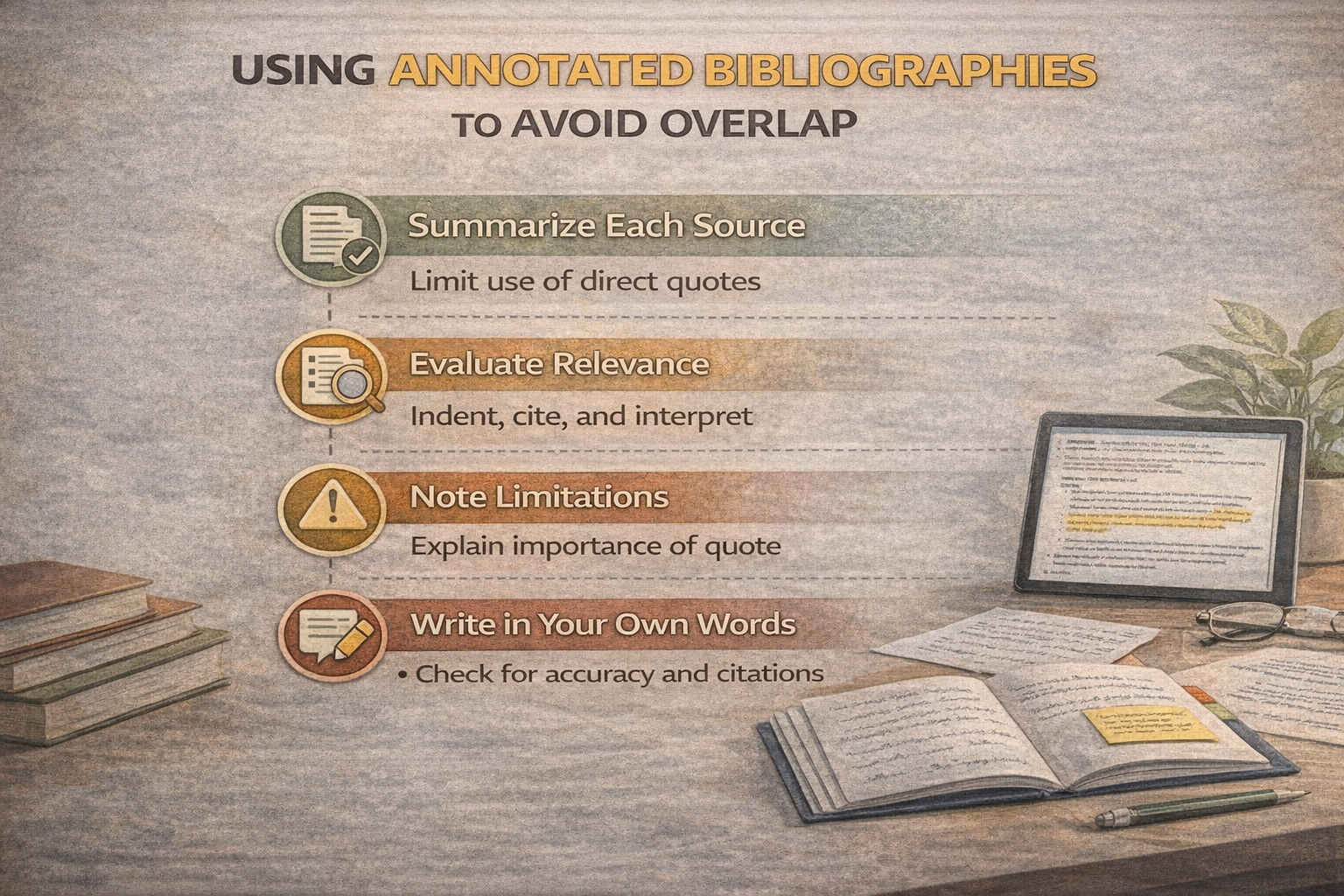
The most effective annotated bibliographies go beyond a one-line summary. Each entry can include three components: the main argument or finding of the source, its relevance to your study, and any limitations or contextual notes. This format ensures that you don’t just understand the material—you connect it directly to your research, making future integration smoother.
For instance, in a management sciences thesis, a source on “employee engagement” might be annotated as: “The paper links employee engagement with organisational productivity in IT companies. Its survey-based methodology could inform my own design for measuring engagement in Indian startups. However, its sample size is small, limiting generalisability.” Such annotations capture the essence without replicating the original wording and also provide cues for critical analysis.
Digital tools like Zotero or Mendeley can be helpful for managing annotated bibliographies, especially for scholars balancing work and research commitments. Many private university faculty members encourage their use, as these tools help maintain a consistent structure and make it easier to insert citations later without confusion.
Avoiding Common Pitfalls
One common mistake is treating annotations as mini copy-paste segments from the source, which defeats the purpose. The value lies in restating ideas in your own academic voice. Another issue is writing overly vague annotations, which may be original in wording but lack enough detail to be useful when writing the final chapters.
Some students also skip the evaluation component, limiting their annotations to summaries. In Indian doctoral research, evaluators appreciate evidence of critical engagement with sources, so a balanced annotation should always include a comment on strengths, weaknesses, or applicability to the research setting.
Indian Academic Context
In the Indian PhD process, especially in private universities, the literature review is often where high similarity scores occur. This is partly because scholars rely on standardised definitions and well-known theoretical frameworks. By starting with an annotated bibliography, you introduce originality early, and when the literature review is drafted, it reflects your own synthesis rather than replicated sequences from multiple sources.
Mid-career researchers, who often have limited time for rewriting large sections, benefit significantly from this method. Once an annotated bibliography is ready, the actual writing phase becomes more efficient, with fewer concerns about post-writing plagiarism removal. This approach aligns well with UGC’s plagiarism guidelines, which reward understanding and originality over mechanical avoidance of similarity.
Conclusion
An annotated bibliography is more than a research tool—it is a safeguard against unintentional overlap and a way to build originality into your writing from the very start. For Indian PhD candidates, particularly in flexible and interdisciplinary environments like private universities, it offers a structured method for absorbing and re-expressing ideas without losing their academic value. Over time, it transforms not only the similarity score but also the depth and quality of scholarly engagement with the literature.