
Introduction
For many Indian PhD scholars, especially those in private universities or working full-time, the decision to hire a thesis consultant is not taken lightly. It usually comes after months of delay, supervisor inaccessibility, or the realisation that handling everything alone isn’t sustainable. But once the decision is made, another kind of uncertainty begins: What actually happens next? What’s the process? Is there a timeline? Will I lose control over my own thesis?
These are valid concerns — particularly in the Indian academic context where processes vary widely across institutions and students are often left to navigate them with little structured guidance. Hiring a consultant doesn’t mean handing over your research. If done right, it’s a step toward regaining clarity and momentum. Understanding what typically happens after you hire a consultant can reduce anxiety and help you prepare for a collaborative, ethical process.
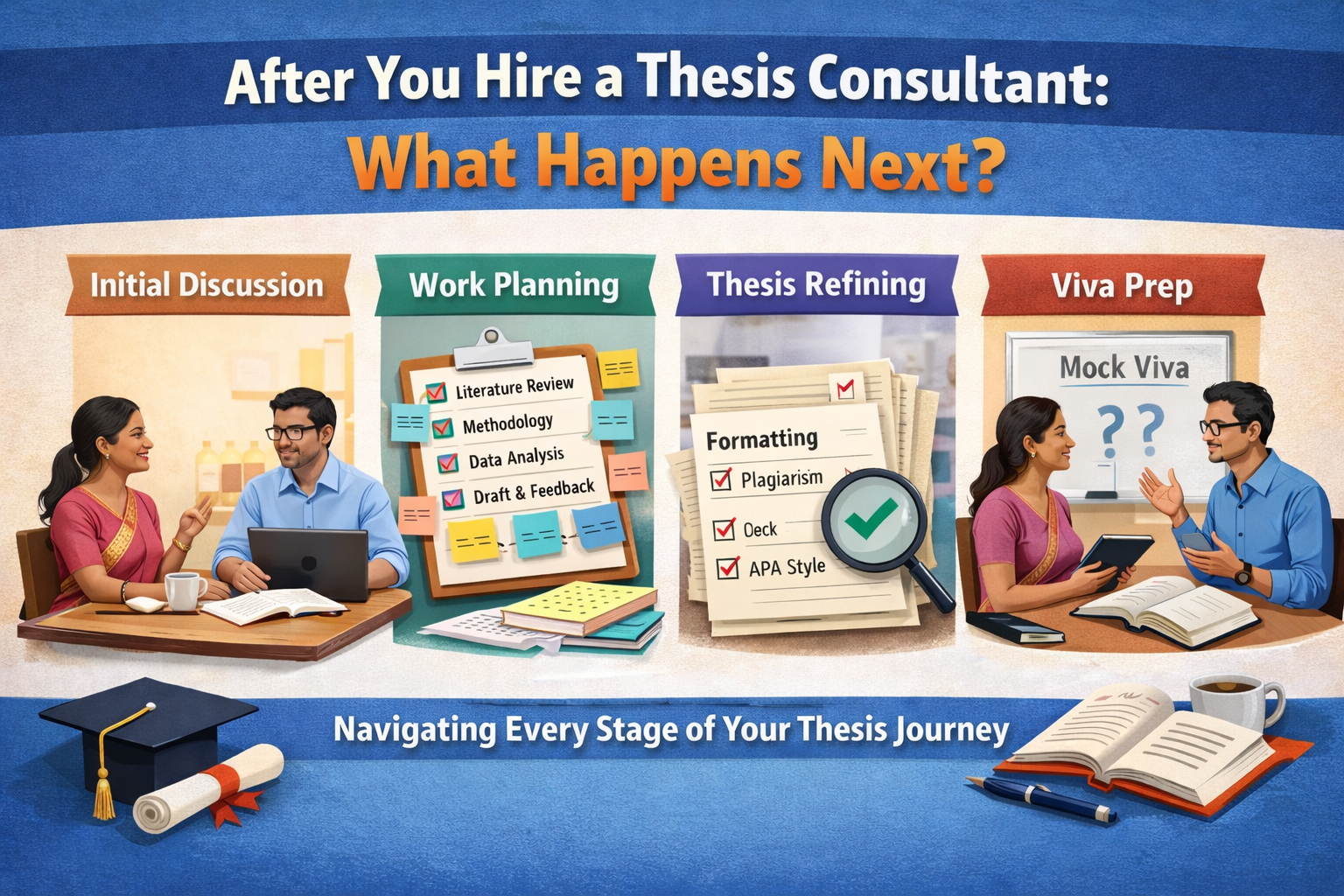
Initial Stage: Discussion, Discovery, and Alignment
Once you connect with a consultant, the first stage isn’t writing — it’s listening. A good consultant will begin with a detailed discussion about your research topic, current status, university guidelines, and what exactly you need help with. This might happen over a phone call, video meeting, or detailed email exchange.
You’ll often be asked to share any drafts, approved proposals, supervisor feedback, or previous submissions. This helps the consultant understand your voice, your academic trajectory, and your challenges.
At this stage, clarity is crucial. Are you looking for writing support, chapter-wise review, literature structuring, or data analysis guidance? The more honest you are about your needs, the more tailored the support will be.
A sociology PhD scholar from a private university in Madhya Pradesh shared how her consultant first spent two weeks just reviewing her proposal and giving feedback — without writing a single line. That foundation saved months of future confusion.
Middle Stage: Structuring the Work and Setting a Timeline
Once alignment is achieved, the consultant typically creates a working plan. This includes deliverables (such as specific chapters or services), tentative timelines, feedback mechanisms, and payment milestones if applicable.
In most Indian consultancy models, the work is delivered in stages. For example:
- Week 1–2: Literature review draft
- Week 3–4: Methodology framework
- Week 5–6: Data analysis assistance
- Week 7–8: First draft of findings
- Week 9–10: Editing, referencing, and formatting
These stages aren’t always linear. Some chapters evolve alongside others. You may be asked to review sections, provide missing inputs, or respond to queries. In fact, a good consultant won’t allow silence — they’ll keep you involved, not to burden you, but to ensure the work remains truly yours.
This stage is also when feedback is incorporated. If your supervisor suggests changes or requests elaboration, the consultant will guide you on how to revise or help you interpret ambiguous comments.
A PhD scholar in business studies from Hyderabad noted how her consultant didn’t just send revised chapters — he also helped her prepare a short justification note for her guide, explaining the updates. This kind of support adds immense academic value without stepping into unethical territory.
Pre-Final Stage: Language, Formatting, and Submission Readiness
Once the core chapters are developed and approved, the final few weeks are often focused on polishing the thesis. This includes:
- Checking for flow and transitions
- Ensuring references are in the correct style (APA, MLA, Chicago, etc.)
- Aligning with university formatting templates
- Plagiarism checks and originality reports
- Language refinement — especially important for scholars writing in English as a second or third language
Many Indian scholars find this stage both relieving and stressful. Relieving, because the bulk of the academic thinking is done. Stressful, because formatting and compliance errors can still derail submission.
A doctoral candidate from Chennai shared how her consultant created a university-specific checklist and ticked off each item before submission — margin size, page numbers, annexures, declaration forms, etc. These details often seem minor, but in Indian universities, they can delay final acceptance if mishandled.
Final Stage: Post-Submission Support and Viva Preparation
Hiring a consultant doesn’t necessarily end with submission. Many scholars seek help for viva preparation, particularly when the supervisor hasn’t had time to conduct mock sessions. This stage may involve:
- Creating short summaries of each chapter
- Anticipating potential questions from the committee
- Preparing clarification notes for specific methodologies
- Reviewing how to explain theoretical frameworks simply
The focus shifts from writing to articulation. A scholar may be able to write a strong thesis but struggle to speak confidently about it in formal settings. This is where a consultant can act more like a coach — helping the student feel prepared, rather than just correcting grammar.
For a part-time scholar in Bengaluru, weekly mock viva sessions with her consultant helped her identify weak explanations and rephrase her arguments clearly. This small step built her confidence during her final defence.
Conclusion
Hiring a consultant for thesis support is not a shortcut — it’s a structured form of academic partnership. For Indian PhD scholars balancing academic expectations with real-world responsibilities, understanding the process that follows this decision is essential.
From the first discovery call to the final polish before viva, every stage has its own rhythm. A good consultant doesn’t just “do the work” — they bring method, communication, and clarity to a journey that can otherwise feel overwhelming and opaque.
Knowing what to expect — and what to demand — can make your research experience more grounded, ethical, and successful. Because when the process is handled right, a consultant doesn’t replace your work. They make your work shine.