
Introduction
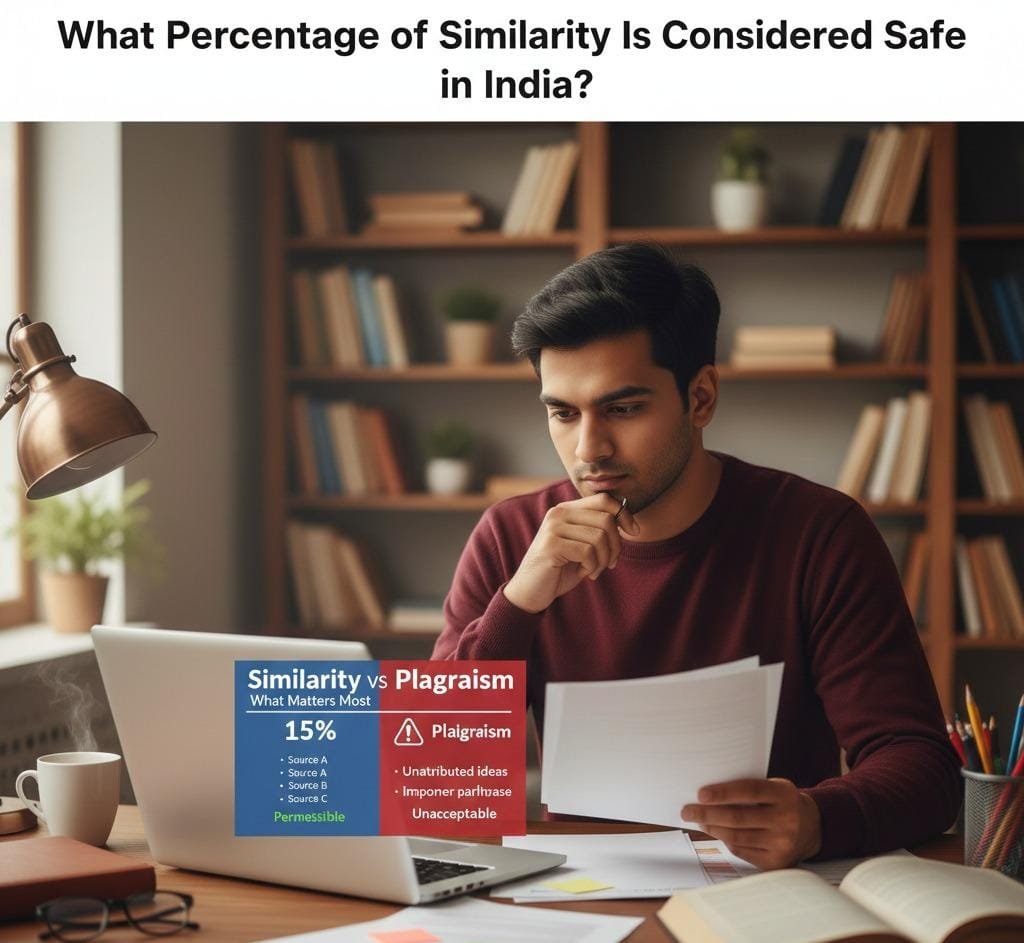
In recent years, plagiarism detection software has become a standard part of thesis submission across Indian universities, especially in private institutions. Most doctoral students are familiar with the anxiety that arises before uploading their thesis to a similarity-checking portal. However, one question continues to trouble many: “What percentage of similarity is considered safe in India?” This concern is not just technical—it often stems from a lack of clarity around institutional norms, the difference between similarity and plagiarism, and the fear of rejection after years of research. In this blog, we’ll explore what is commonly accepted, what really matters, and how Indian scholars can navigate these rules more confidently.
Understanding the Role of Similarity Reports
Similarity reports are not verdicts—they are tools. Most universities in India, especially private universities offering PhD programs, use software like Turnitin or URKUND to detect how much of a thesis matches existing texts. The number produced—called the similarity index—is a percentage that indicates how much content in the submitted document overlaps with existing sources. But this number alone doesn’t tell the full story.
For example, a similarity score of 20% might include correctly cited quotations, references, and methodology descriptions. On the other hand, a thesis with only 10% similarity might still contain improperly paraphrased content or unattributed ideas. This is why interpreting the report matters more than panicking about the number.
What Is Considered Acceptable in India?
In most Indian universities, the UGC suggests that for PhD theses, a similarity index of below 10% is ideal, and up to 15–20% is still acceptable, depending on the section and context. However, many private universities have developed their own internal policies. Some institutions allow up to 25% similarity, provided the matched content is from references, formulaic language in methodology, or properly cited theoretical frameworks.
The key here is the source and nature of the similarity. A match in your literature review that comes from a widely used definition or theory may not be problematic. But copying another scholar’s original argument—even if it’s just one paragraph—without attribution can trigger serious academic consequences.
It’s important to understand that similarity is not the same as plagiarism. A similarity report includes both legitimate overlaps (like references and common academic phrases) and potential plagiarism. Academic panels usually review the report manually to determine whether any unethical borrowing has taken place. Unfortunately, many students assume that a low number automatically means “safe” and a high number means “trouble.” In reality, each case is context-dependent.
How Indian Scholars Can Navigate This Safely
Doctoral researchers in India, particularly those studying in private universities while balancing jobs or family responsibilities, often don’t have structured training in research ethics. This can lead to confusion when their thesis is flagged for high similarity even if they didn’t intend to plagiarise. Institutions are increasingly encouraging research scholars to attend workshops on academic writing and citation practices—but there is still a long way to go.
One of the most effective ways to stay safe is to understand what your university defines as acceptable. If you are working in a private university, speak with your supervisor or the research coordinator about the institution’s plagiarism threshold and whether different sections (like methodology, references, or appendices) are excluded from the similarity calculation.
Use plagiarism tools before formal submission—not just to reduce the percentage but to see where your writing overlaps with existing sources. If most of your matches are in the introduction or literature review, check whether those sections are too close to your sources. Try to rewrite in your own academic voice, even when using standard ideas, and make sure every non-original idea is cited properly.
Conclusion
The safe similarity percentage in Indian PhD submissions is not a fixed number—it’s a guideline shaped by ethics, context, and institutional policy. For most universities, staying below 15–20% with proper referencing is considered acceptable, but what really matters is how responsibly the scholar has acknowledged sources. A clean similarity report should not just be about keeping numbers low, but about demonstrating integrity in your academic work. In the end, your thesis isn’t just a document—it’s a reflection of your research values, and understanding how similarity works is part of that responsibility.