
Introduction
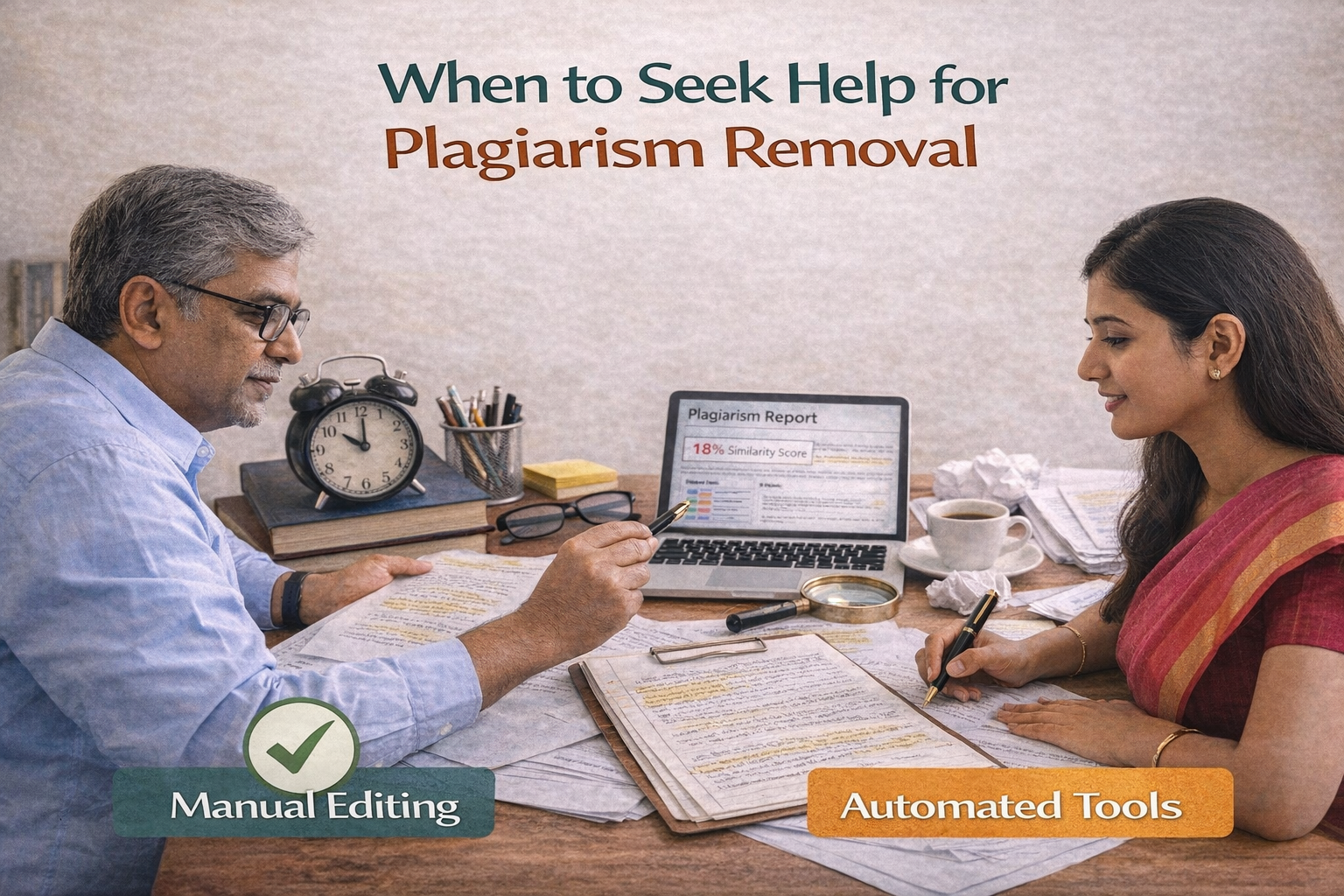
Plagiarism detection has become a routine part of the academic submission process. Yet, for many researchers, especially in Indian academia, understanding when to address plagiarism on their own and when to seek help remains unclear. While minor overlaps can be resolved independently, there are situations where professional support becomes necessary—not just to reduce the similarity score, but to uphold academic integrity without compromising on meaning or structure.
Not All Overlaps Require the Same Response
Similarity in academic writing doesn’t always mean intentional copying. In most cases, overlaps occur due to:
- Incorrect or missing citations
- Poor paraphrasing
- Reuse of your own previously published work (self-plagiarism)
- Use of commonly repeated phrases in your discipline
In such cases, it’s possible to revise sections manually. But when these overlaps are extensive or repeated across key sections, seeking expert guidance can save time and effort while ensuring ethical compliance.
When Self-Correction May Be Enough
If the similarity report shows matches under 20%, and the overlaps are largely in references, standard phrases, or quoted material, you can usually manage the corrections yourself. You may consider:
- Rephrasing sentences more clearly
- Replacing closely matched text with your own academic voice
- Adding missing citations where required
For those confident in referencing styles (APA, MLA, IEEE, etc.), and with sufficient time before the deadline, self-editing is often a reasonable starting point.
Situations That Warrant Expert Assistance
Some similarity issues are not straightforward and may require professional input. Here are a few common situations:
- High Similarity Scores Across Chapters: When major portions of your literature review, methodology, or analysis show significant overlap—even after revision—it’s time to consult a subject-matter editor.
- Repeated Rejections: If a journal or university returns your submission for excessive similarity, a deeper structural review is needed, often beyond your own revision capacity.
- Tight Timelines: When deadlines are near, professional support ensures efficient handling of complex plagiarism without affecting content quality.
- Lack of Confidence in Academic Writing: Especially for non-native English speakers or early-stage researchers, paraphrasing while preserving academic tone can be difficult. In such cases, trained editors can help improve readability and originality.
- Inconsistent Citation Practices: If your citation style is inconsistent or partially applied, an experienced reviewer can correct and align your references as per required standards.
Where to Seek Help
It’s important to choose assistance that is both ethical and relevant to your academic goals. Reliable options include:
- Academic editing services that specialize in plagiarism removal and paraphrasing
- Subject experts with experience in research writing in your field
- University writing support centres (if available)
- Supervisors or research mentors who understand the expectations of your institution
Avoid using unreliable online tools that claim to “spin” or auto-rewrite your text. These often produce low-quality, unreadable content and may introduce further academic risks.
What Professional Help Typically Involves
Experienced editors and plagiarism removal professionals:
- Examine your similarity report line by line
- Identify areas where the meaning needs to be retained but the phrasing must change
- Rewrite content in your academic tone
- Correct citation issues and improve reference accuracy
- Ensure that the final document meets institutional requirements for similarity
Their role is not just technical correction, but helping you develop a submission-ready version of your work that still reflects your original thinking.
Conclusion
Plagiarism removal is not merely about lowering a similarity percentage—it is about responsible scholarship. Knowing when to seek help is part of the research process, not a sign of failure. If your attempts to revise are unsuccessful, if time is short, or if the report is difficult to interpret, don’t hesitate to reach out for academic support. A properly revised thesis or paper strengthens both your credibility and the value of your contribution to the field.