Introduction
Distance education has emerged as a lifeline for students in India who cannot access regular classrooms due to work, family responsibilities, or geographical barriers. However, not all courses lend themselves equally well to distance mode. While some subjects require laboratories, workshops, or constant supervision, others can be effectively delivered through reading material, digital platforms, and occasional interaction. For students considering distance learning, one of the most common questions is: which courses are best suited for this format? The answer lies in balancing flexibility with academic requirements.
The Role of UGC-DEB Recognition
Before looking at specific courses, it is essential to remember that only UGC-DEB approved programs have legitimacy in India. This means that students should not only consider the subject they wish to study but also check whether the program is recognised by regulatory authorities. A degree without proper recognition may not serve its purpose, no matter how well the course fits into distance delivery.
Courses in Humanities and Social Sciences
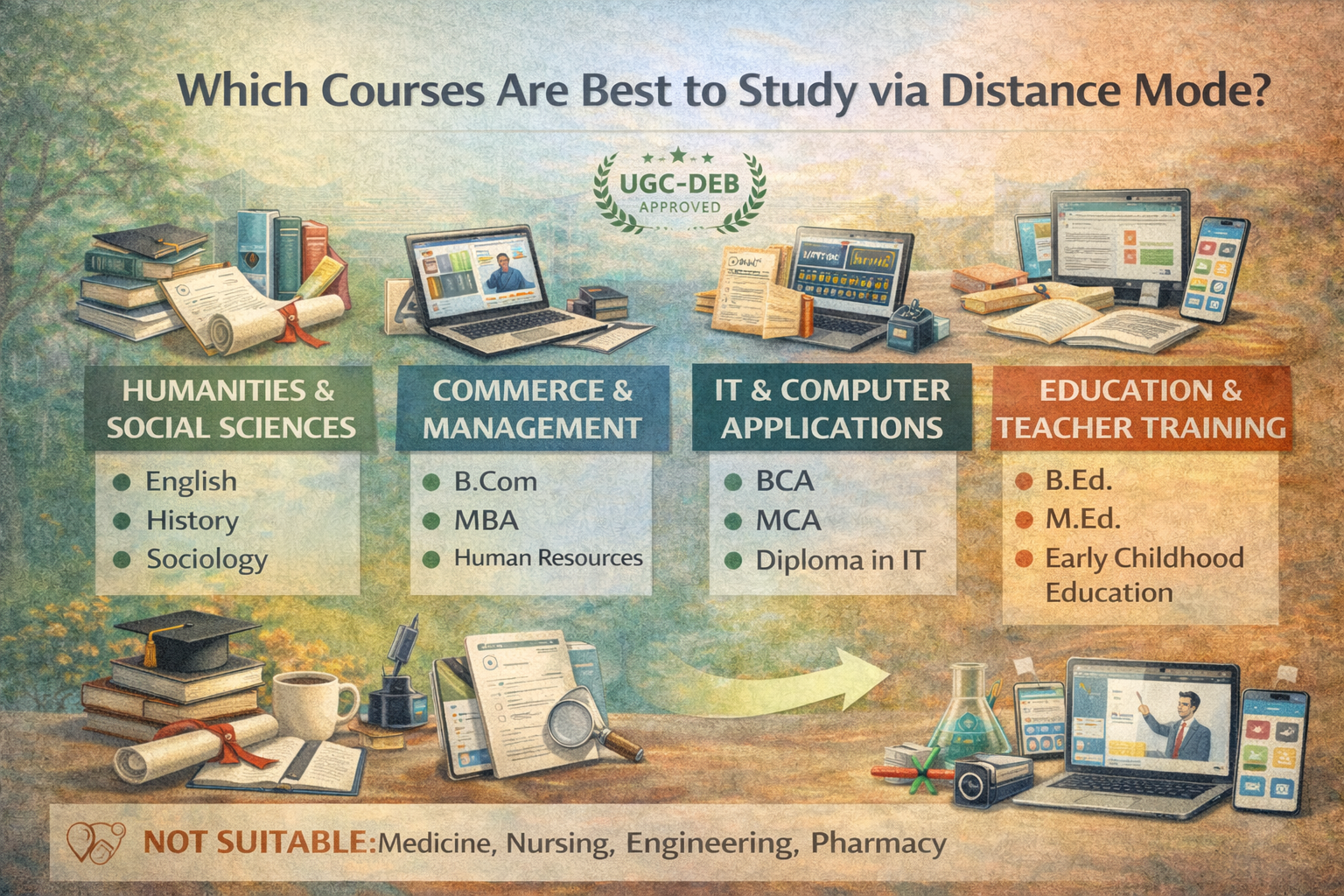
Humanities subjects like English, History, Political Science, Sociology, and Philosophy are among the most popular and suitable choices for distance mode. These disciplines rely heavily on reading, writing, and critical analysis rather than laboratory work. Study materials such as textbooks, recorded lectures, and online discussions can provide sufficient academic exposure.
Social sciences like Public Administration, Social Work, and Economics are also strong candidates for distance delivery. Many students preparing for competitive exams, such as UPSC or state services, opt for these subjects through distance mode because the curriculum aligns well with their preparation.
Commerce and Management Programs
Commerce and management degrees, particularly B.Com, M.Com, BBA, and MBA, are among the most widely pursued courses in distance education. Theoretical grounding in accounting, business studies, marketing, and human resources can be effectively taught through structured study material, case studies, and online assessments.
An MBA through distance mode is especially popular among working professionals in India. It allows them to continue their jobs while upgrading their skills for promotion and leadership roles. With the growing use of recorded lectures and virtual workshops, management education in distance mode has become both practical and industry-relevant.
Information Technology and Computer Applications
While technical degrees like B.Tech or M.Tech are not allowed in distance mode, courses such as BCA, MCA, and Diploma in Computer Applications are commonly offered. These programs work well in distance format because much of the learning revolves around coding, software development, and project-based assignments, which can be practiced independently with the help of digital tools.
Students in remote areas particularly benefit from IT courses in distance mode, as they can gain employable skills without relocating to major cities. With proper access to a computer and internet, these programs open doors to jobs in the IT sector.
Education and Teacher Training
Education-related courses such as B.Ed. and M.Ed. are available in distance mode through select universities approved by the National Council for Teacher Education (NCTE). These programs are valuable for teachers in service who wish to upgrade their qualifications without leaving their schools.
Similarly, diploma and certificate courses in early childhood education, educational technology, or guidance and counselling are highly suitable for distance delivery. By combining printed modules with occasional practical workshops, they strike a balance between theory and practice.
Professional and Skill-Based Programs
Apart from conventional degrees, distance education is also effective for professional diplomas and certifications. Courses in library science, journalism, tourism management, and public relations are well-suited for flexible learning. Many universities also offer short-term programs in entrepreneurship, leadership, and communication skills that enhance employability.
For students aiming to acquire additional skills while working, such programs provide an affordable and accessible option. Unlike highly specialised courses in medicine or engineering, these subjects rely on knowledge transfer and project-based assessments, making them manageable in distance mode.
Courses Not Suitable for Distance Mode
Equally important is recognising which courses are not suitable for distance education. Professional programs in medicine, dentistry, nursing, pharmacy, and engineering require hands-on laboratory work, clinical training, or workshops. These cannot be replaced by study material or recorded lectures, and hence they are not approved for distance delivery in India.
Students should avoid unrecognised institutions that claim to offer such courses in distance mode, as these degrees will not be accepted for employment or further study.
The Growing Role of Technology
The effectiveness of distance courses today is enhanced by digital platforms. Recorded lectures, discussion forums, e-books, and virtual classrooms have narrowed the gap between regular and distance learning. As a result, students pursuing courses like MBA, MCA, or M.A. English in distance mode now experience a more interactive environment compared to the purely correspondence-style education of earlier decades.
Conclusion
The best courses to pursue through distance education are those that rely primarily on theoretical learning, independent study, and flexible assessments. Humanities, social sciences, commerce, management, IT, and teacher education stand out as disciplines that align well with the distance model. Professional and technical courses requiring laboratories or clinical exposure, on the other hand, remain outside its scope.
For students in India, the key lies in matching their career goals with recognised and practical courses. With technology transforming distance education into a more engaging experience, choosing the right program can provide both flexibility and recognition. Distance mode is no longer a compromise—it is a viable and respected pathway, provided students make informed choices.