Introduction
The arrival of AI writing tools has stirred intense debate in academic circles — especially among Indian PhD scholars trying to navigate complex research expectations with limited support. Tools like ChatGPT, Grammarly, or automated citation managers promise speed, convenience, and even coherence. For scholars already stretched thin by teaching loads, family duties, or remote university access, these tools might seem like a solution to long-standing academic struggles.
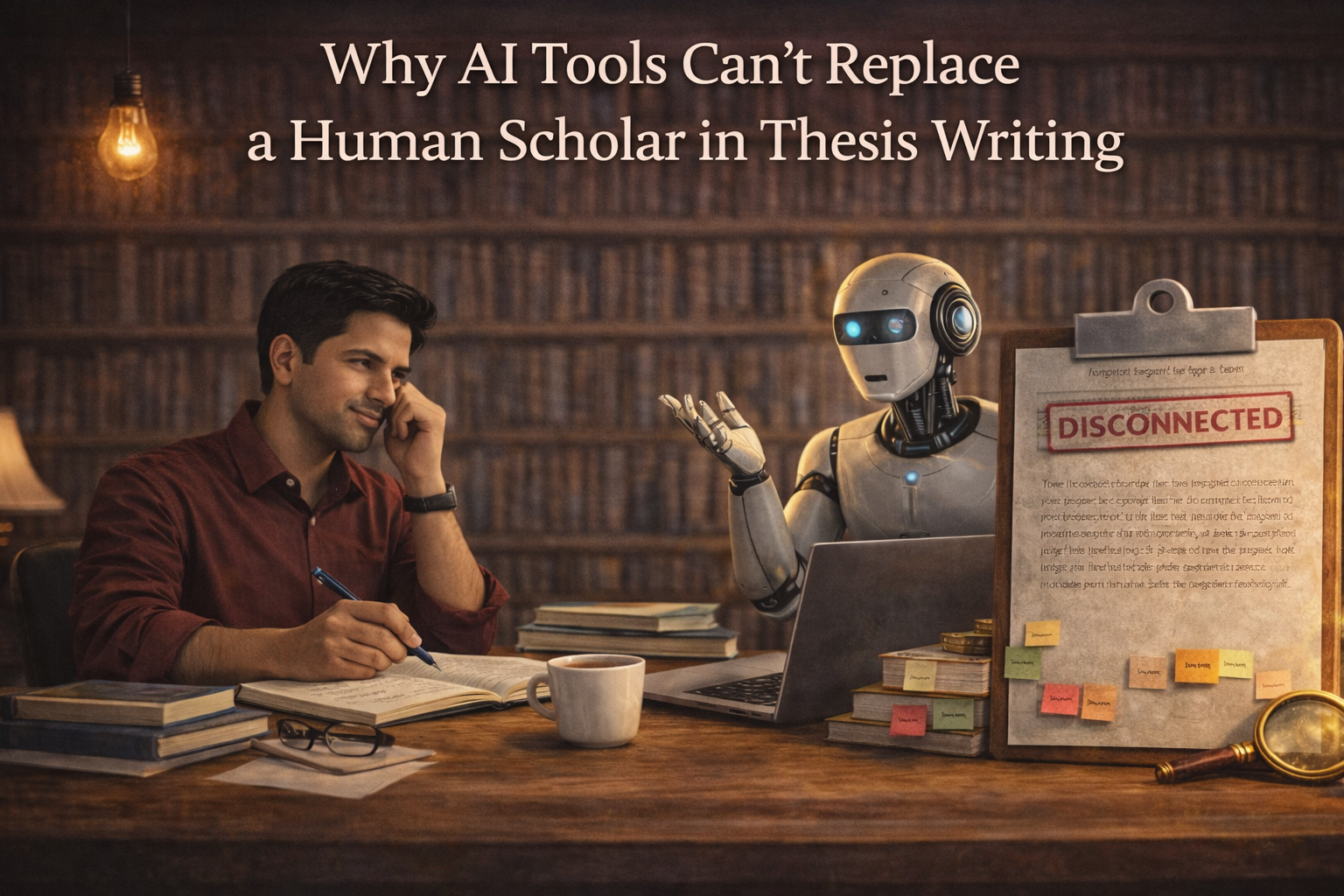
But there’s a deeper question beneath the convenience: Can AI really replace the work of a human scholar? The answer — especially in the context of a doctoral thesis — is no. AI tools can assist, polish, and even simulate academic language. But they cannot replace original thought, contextual judgment, or the emotional and intellectual labour that defines a real research journey. This is not just about academic rules — it’s about the very nature of what it means to be a researcher in India.
AI Can Process Text — But It Can’t Understand Context
At first glance, AI tools seem incredibly smart. Ask them to write an introduction to a thesis on climate policy, and you’ll get a decently structured paragraph. But scratch the surface, and the gaps become clear. AI doesn’t know your university’s specific guidelines. It doesn’t understand the nuanced positioning of your argument within Indian socio-political frameworks. It cannot interpret cultural relevance, policy intricacies, or regional histories with accuracy — unless you feed it highly specific prompts, and even then, it often misses the point.
A scholar working on caste-sensitive education policy from a university in Bihar tried using an AI tool to draft sections of her literature review. What she received sounded polished — but was generic, lacking the depth or awareness needed to discuss marginalisation in the Indian education system. She eventually rewrote most of it by hand, drawing on local case studies and field insights that no algorithm could generate.
Research — especially in an Indian context where lived experience, local variables, and institutional complexity matter — cannot be outsourced to tools trained mostly on global, Western, or surface-level data.
Original Thought, Reflection, and Field Experience Cannot Be Simulated
A PhD thesis is not just a compilation of facts. It is a work of original thinking, built slowly over time. It reflects your choices — what you focus on, what you question, what you critique. Even the gaps in your data or the difficulty you face in literature synthesis become part of your research story.
AI cannot replicate this reflection. It doesn’t struggle. It doesn’t read a complex article five times before understanding it. It doesn’t wrestle with contradictory theories or respond emotionally to participant interviews. Most importantly, it doesn’t care. And that absence of care, however subtle, shows in the writing.
In Indian research contexts — especially in education, social sciences, public health, or regional studies — field experience matters as much as literature. AI cannot analyse your interviews with village teachers, or reflect the silences and hesitations you observed during data collection. That layer of insight, emotion, and cultural intuition is something only a human scholar brings.
Academic Integrity and Institutional Risk
Many Indian universities — especially private ones — are still developing their policies around AI usage. But most are clear about one thing: AI-generated writing, if used to replace your own work, is considered academic dishonesty. The use of tools like ChatGPT to write core sections of your thesis may not always be detectable by plagiarism software, but that doesn’t make it acceptable.
During viva, scholars are often asked to explain their argument structure, justify framework choices, or respond to examiner critiques. If your chapters were written by AI, you’ll find yourself struggling to defend ideas you don’t fully own. This gap can create suspicion, delay approval, or even lead to rejection.
An engineering scholar from a university in Tamil Nadu shared how a peer’s thesis was flagged for review because large sections lacked clarity and coherence during the oral defence. Later, it was found that an AI tool had been used heavily — and while the grammar was correct, the logic wasn’t. The scholar had to rewrite two chapters under supervision.
Academic integrity is not just about avoiding plagiarism — it’s about owning the thinking, the structure, and the limitations of your own work. AI cannot offer that ownership.
Using AI as a Tool — Not a Substitute
This does not mean AI is useless in thesis writing. It can help, if used wisely and with caution:
- Language editing for clarity (especially for scholars writing in English as a second or third language)
- Grammar correction and punctuation checks
- Generating basic outlines or brainstorming prompts
- Referencing tools for citation formatting (like Zotero or EndNote)
- Summarising long articles for early-stage understanding
But these should remain support functions — not content generation. Your argument must still be yours. Your conclusions must still come from your data, your reading, and your reflection.
In fact, working with a human consultant — someone who understands your topic, your voice, and your research goals — offers far more meaningful help than a tool that mimics style without understanding substance.
Conclusion
AI tools are becoming part of academic life, and they will continue to evolve. But they are not a replacement for the human scholar — especially in a PhD journey that demands depth, patience, ethics, and original contribution. In the Indian academic environment, where cultural nuance, institutional variation, and field realities are central, AI simply doesn’t have the understanding needed to do this work with integrity.
As a researcher, you are not just submitting a document. You are building an intellectual legacy — one that reflects who you are, what you care about, and how you think. No tool, however smart, can do that for you. And that is precisely why your presence in the process matters — every step of the way.