
Introduction
With the increasing popularity of AI tools like ChatGPT and Jasper, many Indian PhD scholars are turning to them not only for idea generation, but also for actual writing support. Especially in private universities where thesis guidance is minimal or inconsistent, these tools feel like an accessible solution. But many scholars are now finding that despite clean grammar and sophisticated vocabulary, their chapters are being rejected — or flagged for revision — by guides and external reviewers.
Why does this happen? If the language is fluent and the structure looks academic, why would reviewers push back? The reason lies not just in what is written, but how it sounds. AI-styled thesis language often feels flat, generic, and disconnected from the scholar’s real thinking. For supervisors and reviewers trained to identify authentic academic voice, such writing raises more concerns than clarity. And in India’s PhD ecosystem, especially in viva settings, that disconnection can be costly.
What AI-Styled Language Looks Like – And Why It Feels Suspicious
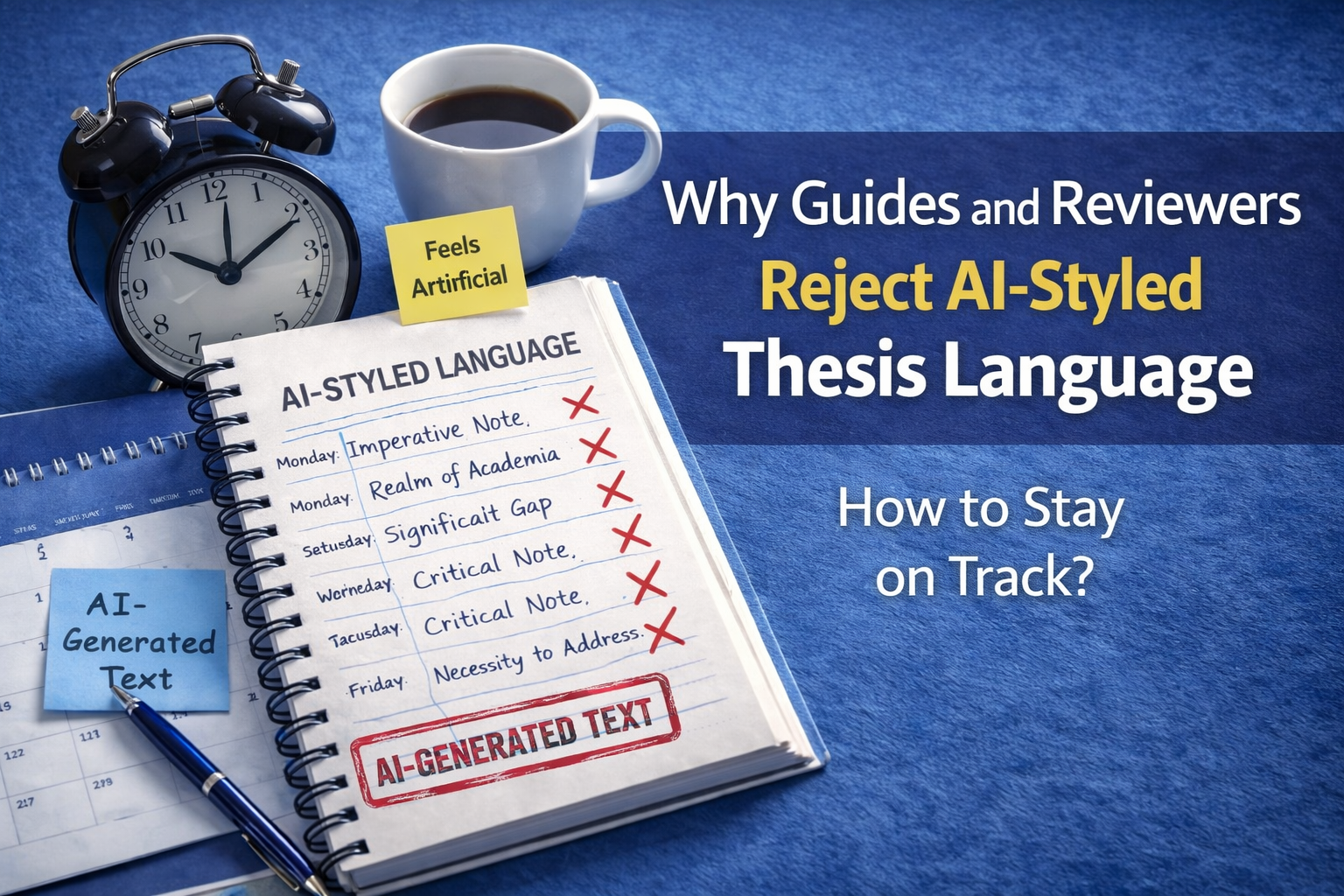
AI-generated text often shares certain patterns: long sentences with overly formal phrases, repetitive structures, vague conclusions, and generic transitions like “In the realm of academia…” or “It is imperative to note…” While these sound polished, they rarely add depth. Worse, they often fail to reflect the actual research context — especially for Indian scholars dealing with local data, field-based research, or interdisciplinary work.
A sociology scholar from a private university in Gujarat shared how her supervisor asked her to revise her literature review because “it didn’t sound like her.” She had used an AI tool to rewrite her summary of key thinkers. Though grammatically perfect, the draft felt hollow — no comparisons, no disagreement, no real insight. Her supervisor sensed this instantly.
Reviewers, especially those with years of academic experience, are trained to notice when a scholar’s writing lacks personal voice. When a paragraph reads like a textbook or a template, they start asking deeper questions: Did the scholar understand the source? Can they explain it in the viva? Does this reflect genuine engagement with the topic?
Why Reviewers Value Voice Over Vocabulary
Contrary to what many scholars believe, reviewers do not expect perfect grammar or fancy vocabulary. What they expect is clarity, ownership, and academic reasoning. Indian PhD guides often have more patience for honest, imperfect writing than for polished text that feels artificial.
In fact, many private university guides now encourage students to submit raw drafts — even with spelling errors — rather than AI-enhanced versions. This is because raw drafts show thought development, confusion, and questions — all of which are part of research growth. AI-styled writing, on the other hand, tends to remove uncertainty. It “fills in” gaps with vague statements rather than acknowledging complexity.
A history scholar from a Delhi-based institution said that her guide asked her to remove several “robotic” lines from her methodology chapter. Phrases like “This research aims to fill a significant gap in existing literature…” had no explanation of what gap, or why it mattered. Her guide’s feedback was simple: Say what you mean — don’t just sound academic.
This reflects a wider truth in research writing: your thesis is not a performance. It’s a record of your thinking. Reviewers reject AI-styled language not because it’s wrong, but because it hides the real work of scholarship — the struggle, the argument, the interpretation.
How to Avoid Falling Into the AI-Language Trap
It’s easy to rely on AI tools — especially under pressure. But scholars can stay within ethical and effective writing practices with a few intentional habits:
1. Write rough drafts in your own voice.
Don’t worry about grammar initially. Just get your ideas down. This makes it easier to build an argument that sounds like you, even if it needs editing later.
2. Use AI only to polish, not to write.
You can use tools like Grammarly or Quillbot to improve clarity after you’ve written a section. Avoid using them to generate entire paragraphs — this is where voice gets lost.
3. Review your writing out loud.
If a sentence feels unnatural when you read it aloud, it probably sounds artificial. Simplify it. Indian scholars often underestimate the power of simple, clear English over heavy academic phrases.
4. Ask a peer or mentor to read your work.
If someone who knows you says, “This doesn’t sound like you,” take that seriously. It’s a signal that the writing may be too edited — or too AI-driven.
5. Insert your observations, not just citations.
AI tools tend to give generic statements. Add your own insights, field notes, or comparisons to make your writing personal and specific.
The Viva Challenge – AI-Style Writing Can Backfire
Perhaps the biggest risk of AI-styled writing shows up during the viva. In India, viva voce remains a key stage of PhD assessment — and it’s oral. Scholars must defend their work in front of a panel, often without notes. If you don’t understand what your own chapter says — or why a sentence was phrased a certain way — reviewers will notice.
Several scholars have shared stories of being asked, “Why did you use this framework?” or “Can you explain this interpretation?” If that part was written by AI — even partially — the scholar struggles to respond. That hesitation, even if brief, can lead to serious doubts. Reviewers may ask for revisions, written explanations, or in some cases, delay degree approval.
Conclusion
AI can assist, but it cannot speak for you. And when it tries to, the result often feels artificial — not just to readers, but to reviewers and guides who know what authentic academic writing looks like. In Indian PhD programmes, especially where supervisors may already be sceptical about student independence, AI-styled language can do more harm than good.
Your thesis is your academic fingerprint. It doesn’t have to be flawless — but it should be yours. The more present you are in your own writing, the more your work will stand up to review, defence, and long-term academic credibility. Guides and reviewers aren’t rejecting polished writing — they’re rejecting writing that feels disconnected. And in research, being connected to your own words is the strongest foundation you can build.