Introduction
As AI tools become more accessible, many Indian PhD scholars are exploring how platforms like ChatGPT, Grammarly, or QuillBot can speed up their thesis work. The idea is understandable. Research in India is often lonely, slow, and unsupported — especially in private universities where guidance varies widely. For scholars juggling teaching jobs, family pressures, and language barriers, AI appears to offer quick relief: instant summaries, reworded sentences, and auto-corrected grammar.
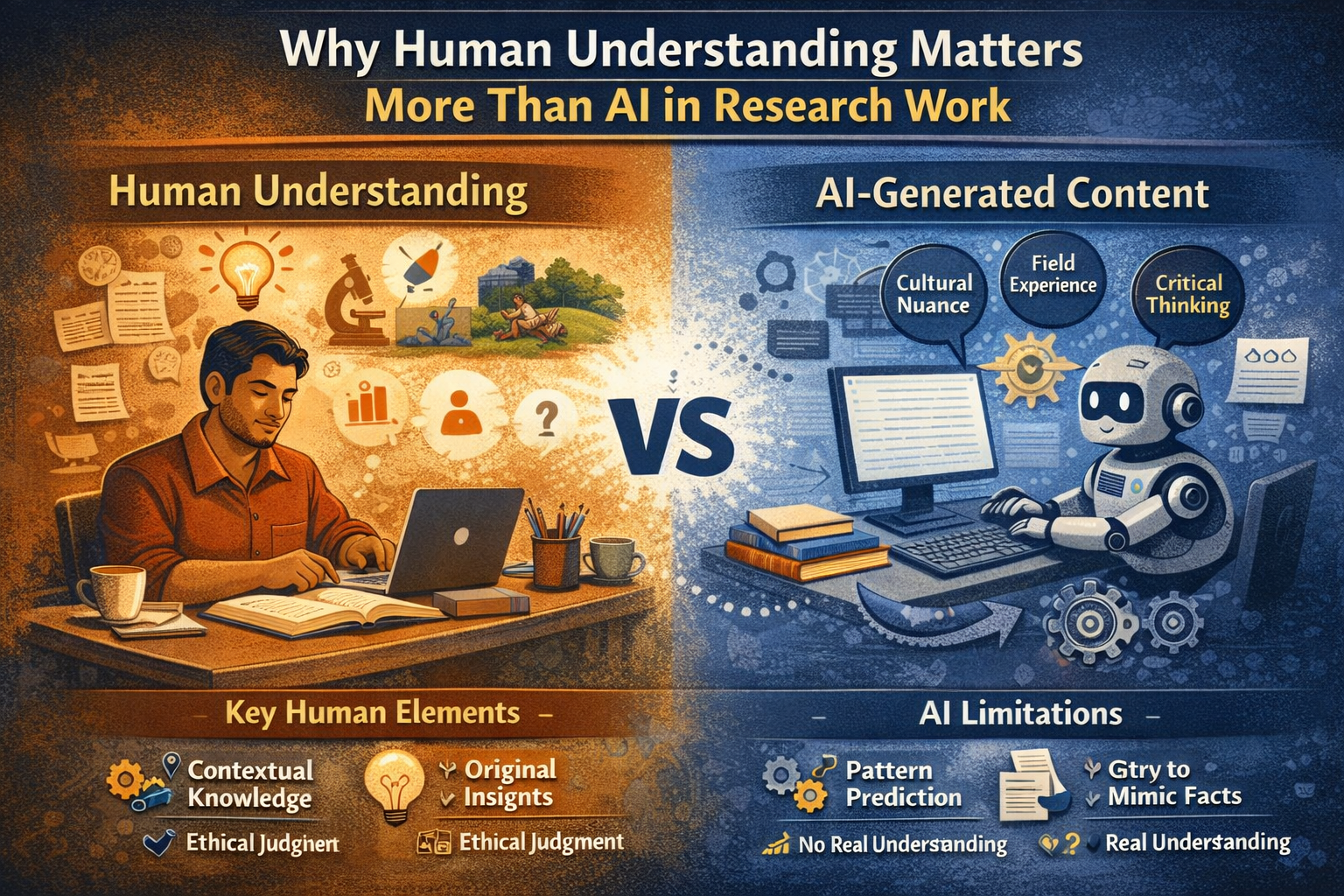
But beneath the convenience lies a deeper question: What makes research meaningful? The answer is not just good language or structured writing. It’s understanding. True research requires critical thinking, contextual awareness, and the ability to interpret complexity — qualities that no AI, however advanced, can replicate. For Indian scholars navigating a diverse, layered academic system, human understanding remains at the heart of meaningful research.
Research Is Not About Information — It’s About Interpretation
One of the biggest myths around AI in academia is the idea that research is about collecting and presenting information. But a PhD thesis is not a data dump — it’s an argument. It’s your interpretation of a problem, your engagement with theories, and your reflection on findings. AI can collect, summarise, and rephrase — but it cannot understand.
A sociology scholar researching tribal displacement in Jharkhand cannot rely on AI to “write” her chapter — because the issue is not just academic. It’s political, emotional, and embedded in real-world struggles. The value of her thesis lies not in how quickly it was written, but in how thoughtfully she engaged with voices, histories, and conflicting policies. AI cannot replicate that emotional and intellectual labour.
Even in technical fields, such as engineering or pharmacy, interpretation matters. Analysing data, justifying why one model was chosen over another, or explaining unexpected results — all of this requires human insight. AI might help describe the data, but it cannot explain why the data matters.
Cultural Context and Ethical Awareness Are Beyond AI’s Reach
In India, research is deeply shaped by cultural, regional, and institutional realities. Whether you’re studying education, health, law, or social policy, you are engaging with a system that is complex, multilingual, and shaped by power dynamics. AI tools, trained mostly on Western data and standardised formats, simply don’t have the cultural depth to handle such topics.
For example, if you are researching gender and migration in Uttar Pradesh, AI can provide general insights about gender roles or migration theories.
But it won’t grasp the local dialect, the social shame attached to women migrating for work, or the informal networks through which families make decisions. These nuances emerge only when a human researcher engages deeply with the field.
Furthermore, AI doesn’t carry ethical responsibility. It doesn’t worry about misrepresentation, citation, or consent. You do. Indian universities expect scholars to conduct ethical research — with informed consent, careful attribution, and respect for participants. AI cannot make those judgments on your behalf. Using it blindly can lead to academic missteps that affect your credibility and integrity.
Voice, Reflection, and Academic Growth Cannot Be Automated
Writing a thesis is not just about producing a document. It’s about becoming a scholar. The long hours of reading, the confusion over frameworks, the rewriting of chapters — all of it contributes to your intellectual development. These struggles may feel slow, but they are essential. They teach you how to think clearly, argue responsibly, and express complex ideas in your own voice.
When AI is used to “do the thinking,” this growth is interrupted. You may end up with neat-sounding text, but very little confidence in what you’ve written. This gap becomes obvious during supervisor meetings or viva voce, where scholars are expected to defend their work. Many Indian examiners now ask direct questions: Why did you choose this framework? What did you learn from your data? If your answer is vague or borrowed, it weakens the entire submission.
A PhD scholar from a private university in Rajasthan shared how he used ChatGPT for writing part of his methodology chapter. His supervisor noticed the overuse of technical jargon and asked him to explain key terms. He couldn’t — because the AI had inserted phrases he didn’t fully understand. That experience made him rethink his approach and rewrite the chapter with more personal clarity.
The Scholar’s Role Can’t Be Replaced — Only Supported
None of this means that AI tools have no place in research. They can be useful when used responsibly. Scholars can use AI for:
• Grammar correction and readability improvement
• Drafting initial outlines or brainstorming questions
• Understanding difficult academic terms
• Summarising long texts for early-stage reading
But these are support functions — not replacements for thinking, writing, or analysing. Your role as a researcher remains central. You bring the questions, the curiosity, the lived experience, and the judgment that shape every chapter. Without that, the thesis becomes a shell — grammatically correct, perhaps, but empty of insight.
Especially in the Indian academic system, where examiners value depth, clarity, and original contribution, no AI tool can substitute for sincere scholarly work.
Conclusion
In the rush to meet deadlines or overcome language barriers, it’s easy to believe that AI can solve the challenges of thesis writing. But research is not about perfect English or fast output. It is about presence — your presence as a thinker, reader, and writer. In every argument you build, every paragraph you revise, every data point you reflect on, it is your understanding that gives the work meaning.
AI can assist with expression, but it cannot feel confusion, make sense of contradictions, or ask uncomfortable questions. That is your job — and it is also your strength. Because what makes your thesis powerful is not how smart the tool was, but how deeply you showed up as a scholar.