
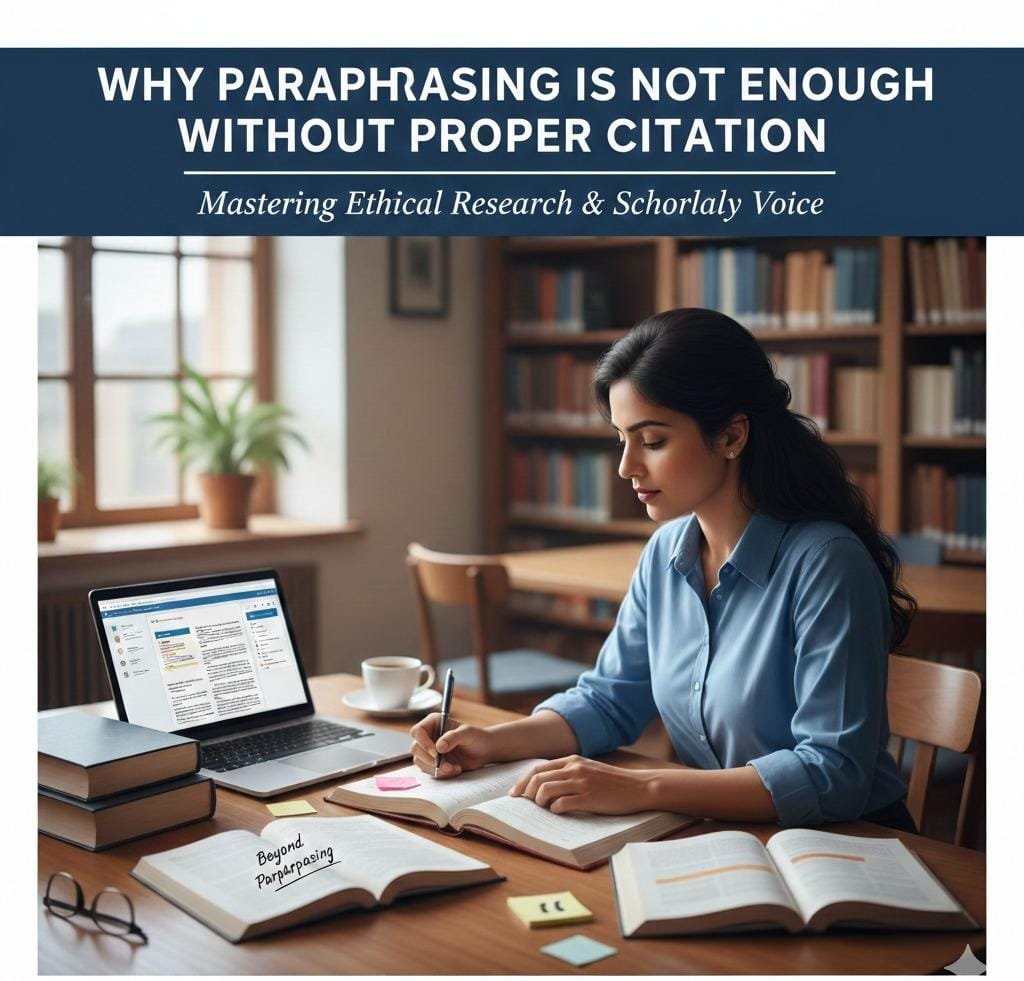
In Indian academia, especially among PhD scholars in private universities, paraphrasing is often misunderstood. Many assume that if they change the wording of a source, they no longer need to cite it. This assumption leads to one of the most common yet serious forms of academic misconduct—plagiarism without realising it. Paraphrasing is a useful writing tool, but when used without proper citation, it still counts as unethical and dishonest. This blog explores why paraphrasing is not enough and why citation is always necessary, even when you’re not directly quoting.
The Misconception Around Paraphrasing
Paraphrasing involves rewriting someone else’s ideas in your own words. While this seems like a way to avoid plagiarism, the idea still belongs to the original author. Changing the structure or vocabulary of a sentence does not make the idea your own. Without citing the source, paraphrasing becomes a subtle form of plagiarism, often overlooked but academically serious.
In private universities, where research awareness and writing support vary widely, many scholars unintentionally fall into this trap. This is especially common among first-generation researchers or those returning to academics after years in the workforce. They often believe that avoiding direct quotes is enough to stay safe—but that’s only half the truth.
Why Citation Is Always Necessary
Even if you paraphrase perfectly, failing to acknowledge the original source is a violation of academic ethics. Citation is about giving credit to the originator of the idea, not just the words. When you include citations, you demonstrate that your arguments are built on credible research, and that you respect the scholarly community.
Citations also help readers trace your thinking, verify facts, and explore related literature. In a thesis, where every argument must be supported by evidence, this becomes even more critical. Proper citation shows transparency and intellectual honesty—two qualities that every PhD thesis must reflect.
The Academic and Ethical Impact
Paraphrasing without citation can lead to serious consequences. Universities use advanced plagiarism detection tools that do more than catch copy-paste—they also identify improperly paraphrased content. If your thesis is flagged, you may be asked to revise it extensively, face delays in submission, or even risk rejection.
More importantly, your credibility as a scholar can suffer. Academic writing is not just about completing a thesis—it’s about building a reputation based on integrity. When you paraphrase without credit, you undermine that trust.
Developing Strong Research Practices
The safest and most effective way to avoid plagiarism is to cultivate the habit of citing all sources, even when paraphrased. Learn to maintain notes of where each idea or data point comes from. Use proper referencing styles recommended by your university. Seek support from supervisors or writing centres if you’re unsure.
In the Indian PhD landscape, especially in private institutions, research culture is still evolving. This makes it even more important for individual scholars to set personal standards of academic honesty. When you make citation a natural part of your writing process, you contribute to raising the overall standard of research.
Paraphrasing is not just a writing technique—it’s a sign that you understand and respect the knowledge you’re engaging with. But citation is what completes the ethical circle. It turns your writing into a conversation with the broader academic world, instead of a monologue that borrows without acknowledgment.
Conclusion
Paraphrasing without citation is like rephrasing someone else’s life story and claiming it as your own. It may not look like a direct copy, but it still lacks originality and honesty. For PhD scholars, especially in India’s private universities, understanding this fine line is not just about avoiding penalties—it’s about becoming responsible researchers. A well-written thesis is not just free of plagiarism; it is built on respect, transparency, and trust in the academic process. Citation is not a burden—it is a badge of your integrity.