
Introduction
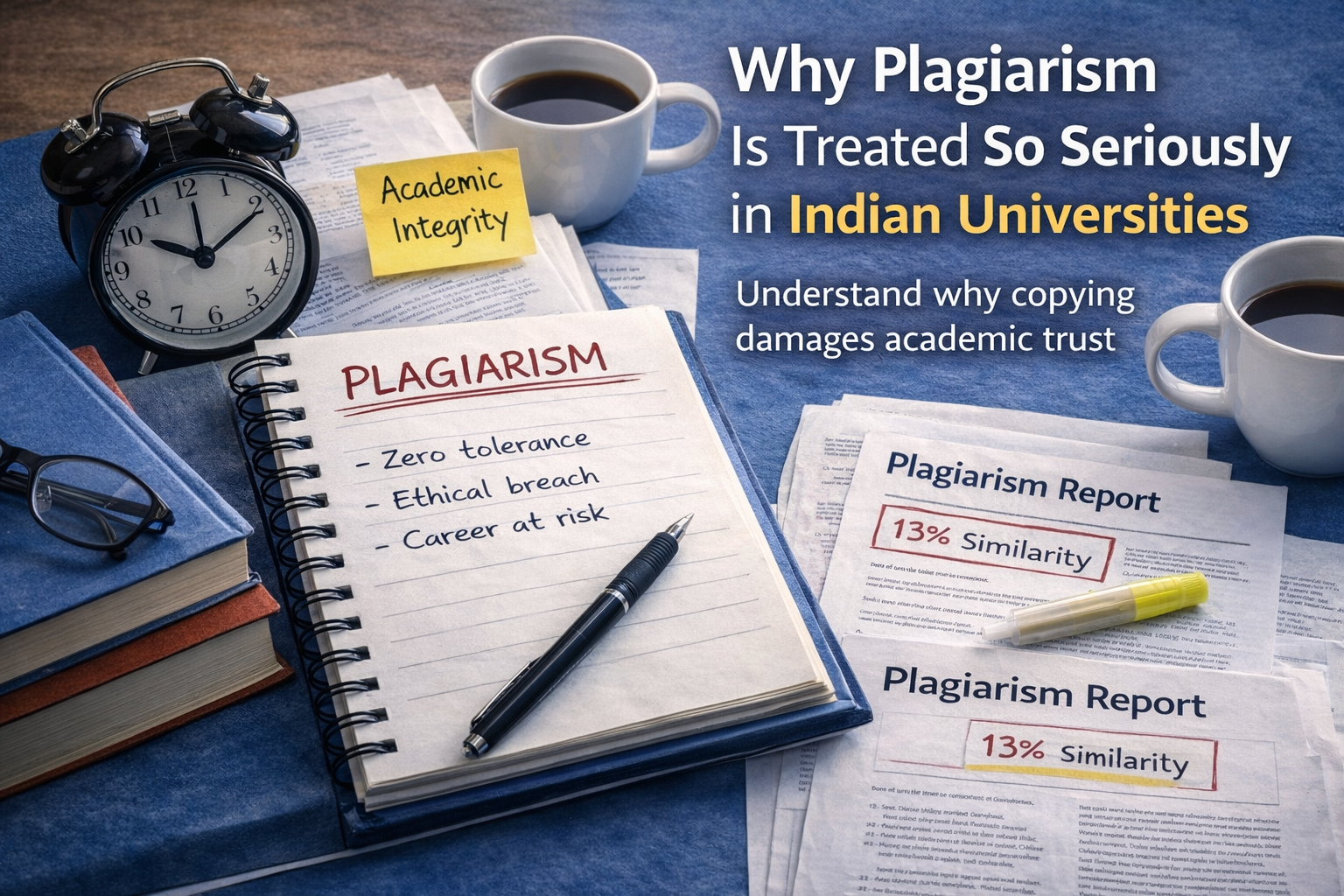
In the Indian PhD journey, one term causes more anxiety than most: plagiarism. It’s mentioned in orientation sessions, guide meetings, and university circulars — often with a sense of finality. “If your thesis has plagiarism, it will be rejected.” That’s the message most scholars receive. But few are told why plagiarism is treated so seriously in Indian universities — especially when academic writing support is limited, and many students genuinely struggle with citations and paraphrasing.
For scholars in private universities, or those returning to academics after years in the workforce, the pressure is even more intense. They’re expected to write in a formal style, often in English, with original arguments and proper referencing — even if they never had structured training in these areas. In such a context, it’s important to understand not just the rule, but the reason behind it. Why is plagiarism seen not as a small mistake, but a serious academic offense?
This blog explores that question, helping Indian PhD scholars understand the deeper logic behind plagiarism policies — and how academic systems view the act of copying, even unintentionally.
Plagiarism Challenges the Core of Academic Trust
Universities function on a basic but powerful idea: that the work submitted by a scholar reflects their understanding. A thesis is not just a long document — it’s a declaration. It says: I have engaged with my topic, I have read the literature, I have formed a view, and I am ready to defend it.
When plagiarism is detected, it breaks that trust. It tells the examiner or the review panel that the scholar is not offering their own thinking, but has instead borrowed without credit. Even if the copied part is small, it creates doubt about the rest of the work. Was the literature review copied too? What about the methodology? Can this candidate be trusted to defend their arguments in a viva?
In Indian academia, where thousands of PhD submissions are reviewed each year and plagiarism detection tools are now widely used, even a few flagged paragraphs can lead to serious questions. It’s not always about the percentage of similarity. It’s about the message it sends — and the integrity it calls into question.
That’s why plagiarism, even when accidental, is treated not as a technical glitch but as an ethical breach. It’s not just about copying text — it’s about breaking the unspoken agreement between the scholar and the university.
India’s Unique Academic Landscape Makes the Risk Higher
In many Indian universities — especially private or deemed institutions — scholars come from varied educational and linguistic backgrounds. Some are full-time researchers, while others balance jobs, family, and part-time study. English may not be their first language. Citation norms may be unfamiliar. And institutional guidance is not always consistent.
This mix of challenges makes scholars vulnerable to both unintentional plagiarism (copying without realising) and outsourced plagiarism (paying someone who submits copied work). Because of these risks, Indian universities have had to become stricter.
Many now use software like Turnitin, URKUND, or Ouriginal as part of the final submission process. But beyond the software check, what universities are really concerned about is reputation. If theses from an institution are found to contain copied material, it damages the university’s credibility — both nationally and internationally. This can affect rankings, grants, research collaborations, and even the approval of future PhD seats by regulatory bodies.
For this reason, departments are often under pressure to ensure zero tolerance. Even if a scholar says, “I didn’t know,” the system may not offer much flexibility. Plagiarism becomes more than a personal mistake — it becomes a potential institutional liability.
What This Means for Scholars — Especially in Private Universities
Understanding why plagiarism is treated seriously should not lead to fear — but to awareness. If you are a PhD scholar in India, especially in a private university where academic mentorship may vary, here’s what this means for you:
- Your words are your responsibility: Whether you hired a consultant, used AI tools, or took help from a friend — what you submit under your name must reflect your voice and your learning. If a part is borrowed, it must be cited. If a paragraph is not yours, don’t include it. Simple as that.
- Don’t assume small copying is safe: Some scholars believe changing a few words is enough. Others think that if only 10–15% of the document is similar, they’ll pass the software check. But even small copied sections — especially in the introduction or conclusion — can trigger red flags.
- Consult your guide early: If you’re unsure about how to cite something, ask. Many guides prefer over-citation to under-citation. Waiting until submission and hoping the software won’t detect issues is a dangerous gamble.
- Be careful with freelancers or AI-generated content: If someone offers to “write your chapter quickly,” ask them where they’re getting the content from. If it’s copied from old theses or academic blogs, the software will catch it. If it’s AI-generated, it may still be flagged — and may not even reflect your argument correctly.
The goal is not perfection. It’s ownership. When you write honestly, even if it takes longer, your work will withstand scrutiny — and you’ll be able to defend it confidently at every stage.
Conclusion
Plagiarism is treated seriously in Indian universities not because the system is rigid, but because academic trust is fragile. In a thesis, every word carries the weight of your name, your research journey, and your scholarly integrity. If a part of that is copied without credit — whether intentionally or by accident — it affects how the entire work is viewed.
For Indian PhD scholars, especially those managing complex research lives, the temptation to copy or rely too heavily on external help is understandable. But the cost is often not worth it. A thesis written slowly, thoughtfully, and in your own voice will not only pass software checks — it will pass the deeper test of academic honesty.
Plagiarism is not just a rule to follow. It’s a value to uphold — for your university, your research community, and most of all, for yourself.