
Introduction
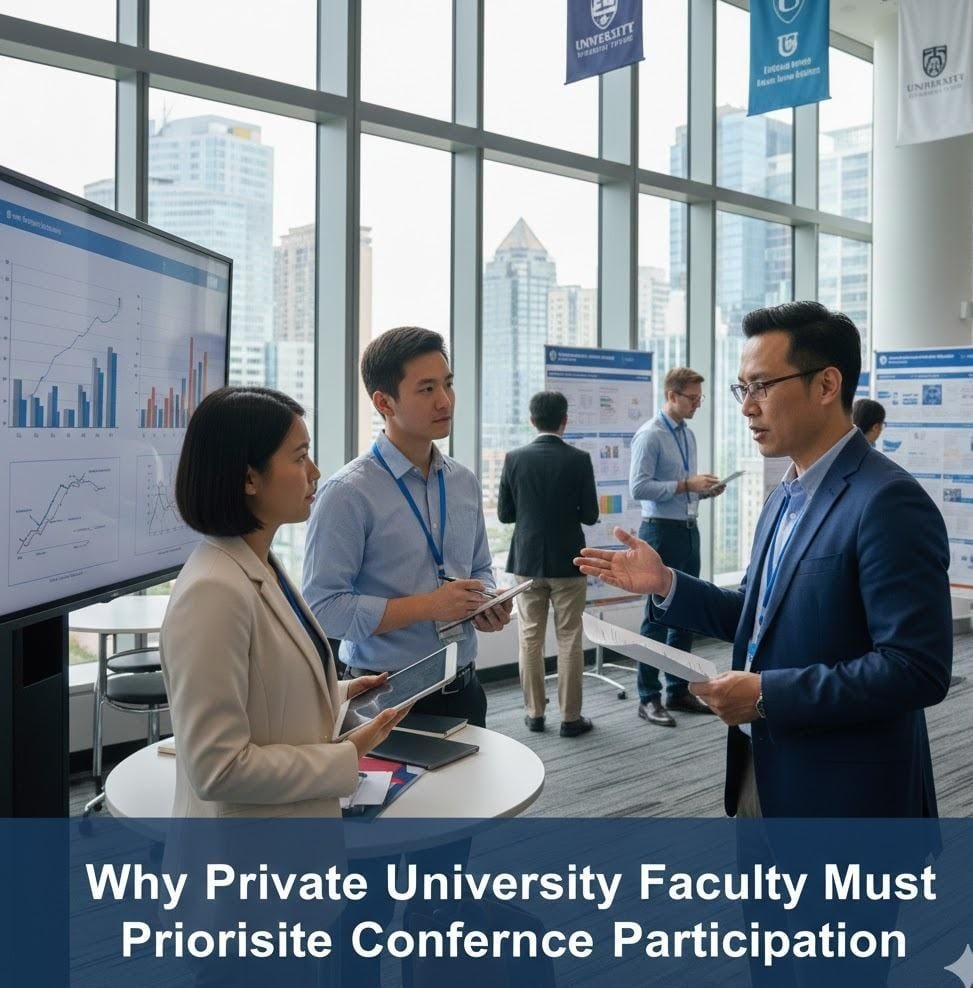
In India, private universities have grown rapidly over the past two decades, offering opportunities for both students and faculty. Yet, one challenge many faculty members face is establishing credibility and visibility within the wider academic community. While teaching and internal research are important, conference participation plays a crucial role in shaping professional reputation. For faculty in private universities, prioritising attendance at academic conferences is not just beneficial — it is essential for building recognition, enhancing research profiles, and staying current in a competitive higher education landscape.
Enhancing Academic Recognition
Conference participation allows faculty members to showcase their research to a larger audience beyond their institution. In India, where private universities may still be building their reputations, visibility in scholarly circles becomes particularly significant. Presenting papers, participating in panels, or chairing sessions signals active engagement with the field and highlights expertise. A faculty member presenting at a national conference can gain recognition from peers at older public universities, bridging gaps in perception and building credibility in both teaching and research domains.
Additionally, conferences serve as evidence of professional growth that can be included in annual appraisals or promotion dossiers. In many private universities, career progression is influenced not only by publications but also by visible contributions to the academic community. By participating in conferences, faculty members demonstrate initiative, scholarly engagement, and commitment to advancing their discipline, which strengthens their standing within the institution and beyond.
Networking and Collaborative Opportunities
Conferences are fertile grounds for networking. Faculty members can meet experts, potential collaborators, and even funding bodies. In India, where academic collaborations often depend on personal connections, these events provide opportunities that may not arise within the limited circle of a single university. For private university faculty, building relationships with peers from established institutions can lead to joint research projects, co-authored papers, or invitations to contribute to edited volumes. These collaborations enhance both professional growth and the university’s academic reputation.
Beyond professional contacts, conferences also provide a platform to exchange teaching practices, explore interdisciplinary approaches, and gain insight into emerging research trends. Exposure to diverse methodologies and ideas encourages innovation in research and pedagogy, which benefits both faculty and students.
Professional Development and Confidence
Participating in conferences develops skills that extend beyond research. Faculty members improve their academic writing, public speaking, and ability to defend arguments under scrutiny. In the Indian context, where faculty often juggle teaching, administrative duties, and research, conferences provide focused environments for intellectual growth. Handling questions, engaging in panel discussions, and interacting with peers cultivates confidence and enhances one’s profile as a thought leader in the field.
Faculty who regularly present at conferences also model professional behaviour for their students. PhD candidates and young researchers gain inspiration from mentors who actively participate in scholarly discussions, demonstrating that research is not confined to classrooms or offices but thrives in wider academic dialogue.
Strategic Participation and Institutional Benefits
While time and resources can be constraints, strategic selection of conferences maximises benefits. Prioritising events aligned with one’s research interests, attending regional or national gatherings with high academic visibility, and balancing travel commitments with teaching responsibilities ensures that participation is meaningful. For private universities, faculty presence at conferences also contributes to institutional recognition, signaling engagement with the broader academic community and reinforcing the university’s commitment to quality research.
Conclusion
For faculty in Indian private universities, attending conferences is more than an optional activity; it is a cornerstone of professional growth and academic recognition. Beyond enhancing research visibility, conferences foster networking, skill development, and exposure to emerging trends. Prioritising these opportunities strengthens not only individual careers but also the university’s reputation, creating a culture of active scholarly engagement. In the fast-evolving landscape of Indian higher education, faculty who embrace conference participation position themselves and their institutions for meaningful, long-term academic impact.