
Introduction
For many Indian PhD scholars, the first experience of seeing a plagiarism report can be unsettling. A similarity percentage higher than the acceptable limit is not just a number; it is a sign that the work needs closer attention before submission. In universities across the country — from private institutions with flexible timelines to traditional public research bodies — plagiarism checks have become an integral part of the academic process. While some assume that removing plagiarism is a matter of simply replacing a few words with synonyms, the reality is far more layered. Genuine plagiarism removal involves protecting the integrity of the research while ensuring it stands as an original academic contribution.
In doctoral work, originality is not just a formality for clearing a similarity threshold; it reflects the scholar’s intellectual ownership of their ideas. This is why treating plagiarism removal as a mechanical exercise in rewording can be misleading. The process demands a deeper engagement with the content, sources, and structure of the work, ensuring that revisions strengthen the thesis rather than weaken it.
Understanding the Limits of Rewording
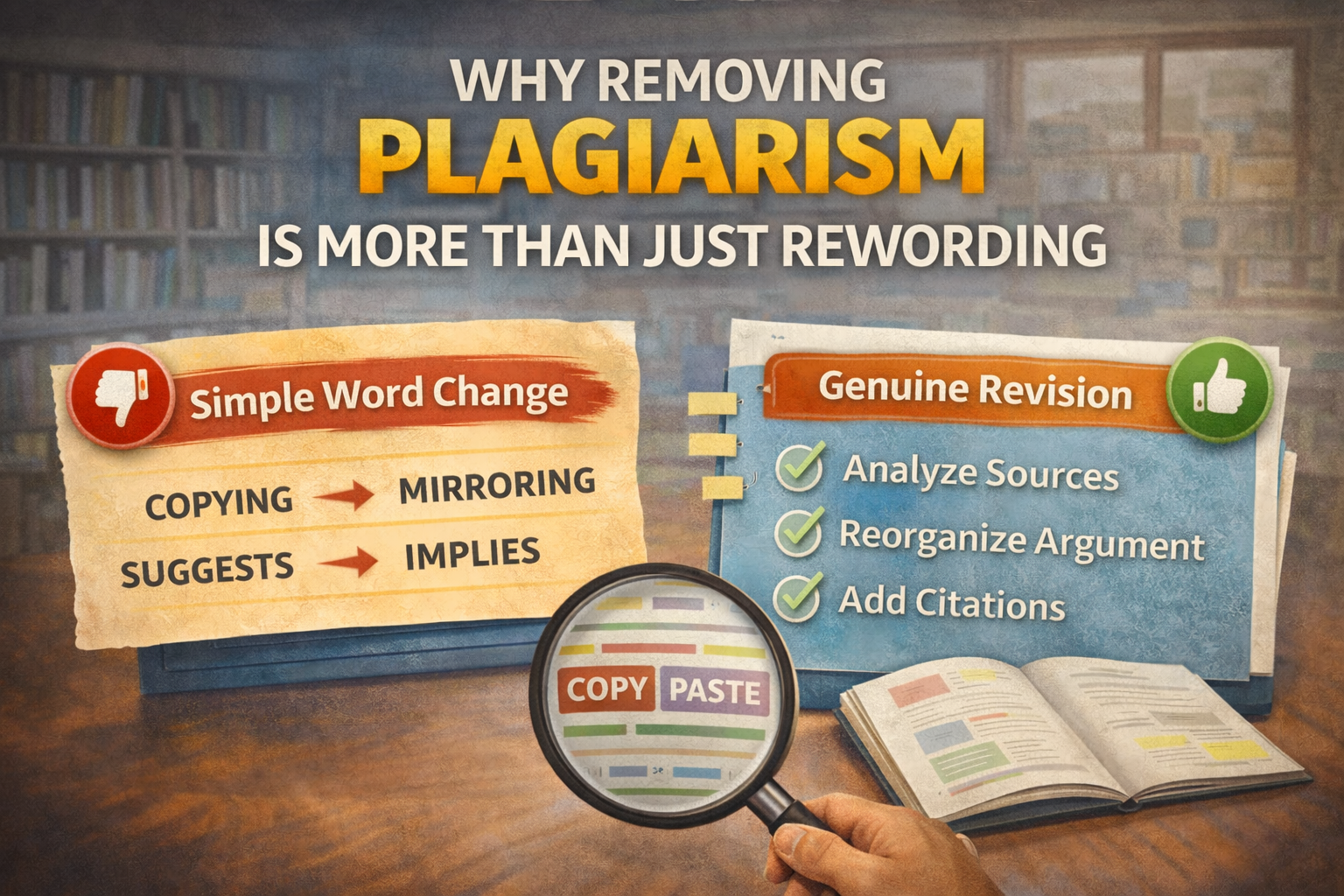
Rewording might address some surface-level similarities, but it cannot resolve issues where the structure, argument, or flow of the work closely follows an existing source. For example, in a literature review, merely changing words without altering sentence construction or perspective may still be flagged by similarity detection tools. Moreover, some technical terms, field-specific phrases, or standard definitions cannot be replaced without losing accuracy. In such cases, the challenge is not finding alternative vocabulary but demonstrating an original synthesis of existing knowledge.
The Role of Source Integration
Removing plagiarism effectively often requires a different approach to integrating sources. Instead of relying heavily on a single reference, a stronger method is to draw from multiple sources, comparing perspectives and presenting them in the scholar’s own analytical voice. This not only reduces overlap but also improves the depth of the research. For instance, a PhD candidate in education might replace a heavily paraphrased section from one author with a balanced summary of three or four studies, linked by their own interpretation of trends or gaps in the literature. This shift from rewording to rethinking makes the content truly original.
Citation Practices and Academic Integrity
Another aspect that makes plagiarism removal more than just rewording is proper citation. In Indian academia, especially at the doctoral level, inadequate referencing is one of the most common reasons for similarity reports to rise. Even if the text is rewritten, failing to credit the original idea still counts as plagiarism. Correctly attributing concepts, data, and arguments not only satisfies institutional requirements but also demonstrates scholarly honesty. Supervisors often encourage scholars to revisit their referencing style during plagiarism correction, aligning it with accepted citation standards such as APA, MLA, or Chicago.
Restructuring for Original Thought
In some cases, plagiarism removal calls for rethinking the organisation of the content itself. If a section’s structure closely mirrors that of a published work, rewriting sentences will not suffice. The scholar must reorganise the argument, present evidence differently, and perhaps even develop new examples or case studies. This restructuring not only avoids plagiarism but also enhances the clarity and persuasiveness of the work. For example, a management PhD thesis might replace a copied industry example with one based on the scholar’s own fieldwork or data analysis.
Addressing Discipline-Specific Challenges
Each field of study in India presents its own hurdles when it comes to originality. In sciences and engineering, certain methodologies and result descriptions follow established patterns, making them prone to similarity flags even when independently produced. In humanities and social sciences, the risk often lies in long passages of paraphrased theoretical frameworks. Overcoming these challenges requires more than changing words; it involves presenting information with a fresh interpretive angle or connecting it to unique data collected during the research.
Time and Effort in the Process
The belief that plagiarism can be removed overnight through quick rewording often leads to disappointment. Genuine removal takes time, as it may require revisiting sources, reading additional literature, and rewriting entire sections to reflect an independent understanding. For working professionals pursuing a PhD in India, this means balancing plagiarism correction with job responsibilities and other commitments. The time invested, however, often results in a stronger, more defensible thesis.
Building a Culture of Originality
Approaching plagiarism removal as an exercise in academic growth rather than a technical hurdle changes how scholars engage with their work. Instead of aiming to simply reduce a similarity score, the focus shifts to improving the argument, refining the evidence, and strengthening the overall presentation of ideas. This approach aligns with the broader goal of doctoral education in India — not just producing a thesis, but contributing meaningfully to the chosen field.
Conclusion
Plagiarism removal, when done properly, is far more than the act of substituting words. It is a process of re-engaging with the research, questioning how sources are used, and ensuring that the work reflects the scholar’s own academic voice. For Indian PhD candidates, particularly those navigating the demands of both academia and professional life, this deeper approach may take more time but ultimately results in a thesis that is both original and credible. Rewording may lower a percentage on a report, but genuine scholarly revision ensures the work stands the test of academic scrutiny.