
Introduction
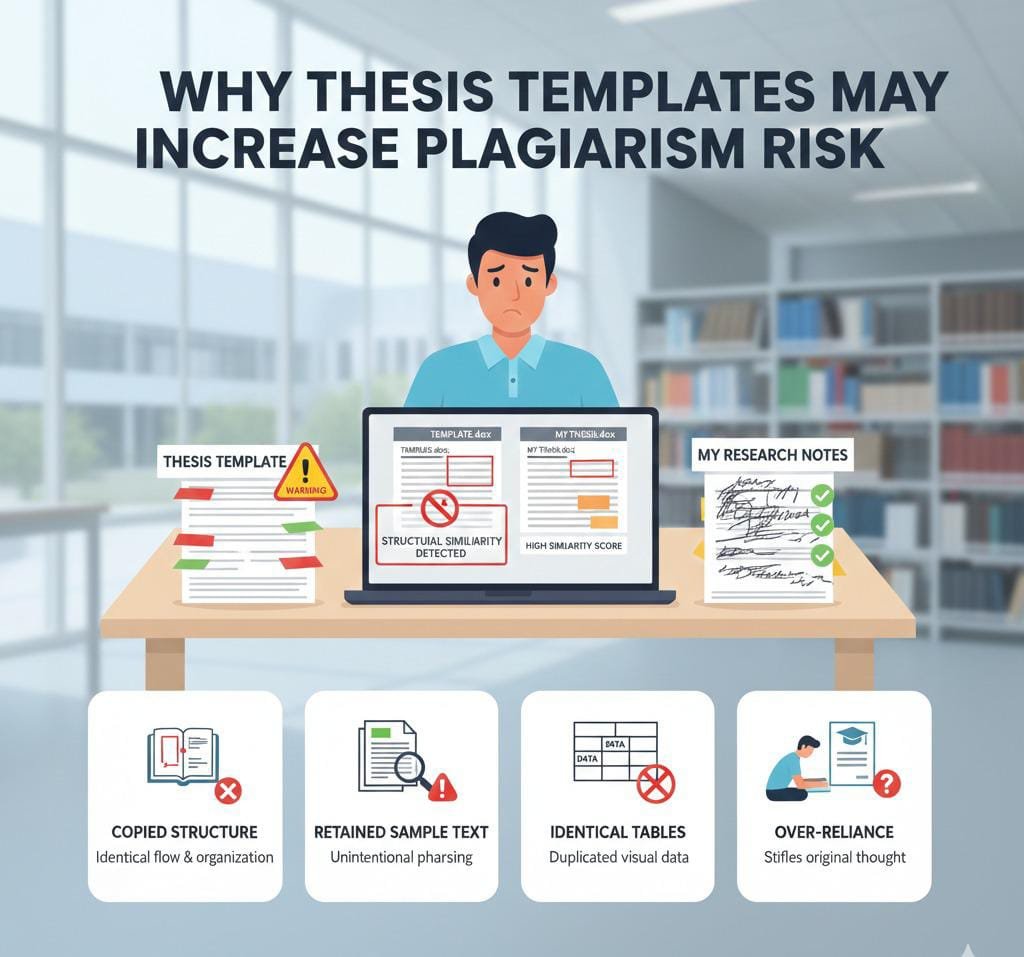
Thesis templates are a common resource for PhD scholars, especially in Indian private universities. They offer ready-made formatting, pre-set headings, and sample content that can save time. At first glance, they seem harmless—after all, they are meant to guide rather than replace your work. But UGC’s plagiarism guidelines highlight a less obvious problem: templates can lead to unintentional plagiarism, particularly when scholars retain too much of the original wording or structure.
What Makes Thesis Templates Attractive
For a first-time researcher, writing a thesis from scratch is overwhelming. Templates offer:
- Pre-formatted chapters and headings.
- Examples of abstracts, introductions, and literature review structures.
- Ready citation styles and bibliography formats.
- Built-in tables and figures for easy data presentation.
By reducing the technical side of formatting, they allow scholars to focus on writing content. However, convenience often comes with hidden risks.
How Templates Can Lead to Plagiarism
- Retained sample text: Many templates include example sentences that end up staying in the final thesis.
- Copied structural flow: Following the same sequence of arguments and chapter layout can count as structural plagiarism if not adapted.
- Identical data presentation: Tables, graphs, and figures in templates are sometimes reused without modification.
- Over-reliance on one source: If a template is based on a single previous thesis, its unique style can carry over into your work.
UGC Guidelines on This Issue
According to UGC’s 2018 regulations on academic integrity, plagiarism is not limited to direct copying. Even reusing the format, structure, or “substantial similarity” from another work without proper acknowledgment can be flagged. For private universities, this means that simply using a popular thesis template could result in multiple theses looking strikingly similar—raising suspicion during evaluation.
Safe Ways to Use Thesis Templates
- Customise completely: Change headings, section titles, and formatting to suit your research style.
- Replace all sample text immediately: Don’t leave any placeholder content unchanged.
- Adapt visual elements: Redesign charts, graphs, and tables to match your own research data.
- Mix resources: Combine ideas from multiple templates to avoid close similarity to a single source.
- Cite if applicable: If the template is taken from a published thesis or university resource, credit it in your acknowledgements.
Mistakes to Avoid
- Submitting a thesis with unchanged sample paragraphs from the template.
- Copying the literature review format word-for-word.
- Using the same sequence of headings as another scholar’s thesis without modification.
- Relying on outdated templates that may already have been flagged for plagiarism.
Why Over-Dependence Can Harm Your Thesis
Using a template too strictly can:
- Reduce originality in your writing style.
- Make your thesis look formulaic and uninspired.
- Increase the risk of plagiarism detection due to structural similarities.
- Limit your ability to meet specific university requirements that differ from the template’s format.
Conclusion
Thesis templates can be valuable tools when used with caution. For PhD scholars in Indian private universities, the safest approach is to treat them as loose guides, not fixed blueprints. UGC’s plagiarism rules demand originality not just in words but also in presentation and structure. By customising thoroughly, replacing all sample content, and diversifying your sources of inspiration, you can enjoy the convenience of a template without risking your academic integrity. Ultimately, your thesis should reflect your unique research journey—not just the skeleton of someone else’s work.