
Introduction
Across India’s higher education system — from reputed central universities to private institutions — there is a growing unease about the role of artificial intelligence in academic writing. What began as curiosity about AI tools like ChatGPT, GrammarlyGO, or Jasper is now turning into official concern. Several top universities have already issued formal advisories or guidelines cautioning PhD scholars against using AI tools for thesis writing. These aren’t vague warnings — they are rooted in real academic risks.
For Indian PhD students, especially those pursuing research in English as a second language or working alongside jobs, the temptation to rely on AI for paraphrasing, summarising, or even drafting is understandable. But universities are drawing a line — not because they fear technology, but because they are committed to protecting the core value of a thesis: authentic, independent thinking.
Understanding why these institutions are raising red flags is important — not just to avoid penalties, but to recognise the broader academic principle at stake.
What the Warnings Really Mean
When universities advise against using AI in thesis writing, they are not objecting to all forms of digital support. Most accept tools like citation managers, grammar checkers, or reference software. What they object to is the use of AI to generate, rephrase, or rewrite original academic content — especially without acknowledgement.
AI tools may not plagiarise directly, but they still raise questions around authorship. A thesis written largely with AI assistance may look polished, but it lacks the depth and internal logic that comes from long-term engagement with a topic. And this absence is often detected — not just by plagiarism software, but by human guides and reviewers who can sense when a scholar is not fully in control of their own work.
Top Indian universities have begun adding explicit clauses in their thesis submission policies. These include statements like:
- “AI-generated content must not be included unless explicitly acknowledged and approved.”
- “Scholars are expected to maintain ownership over all parts of the thesis, including literature synthesis and discussion.”
- “Detection of AI-generated chapters may lead to revision requests or ethical scrutiny.”
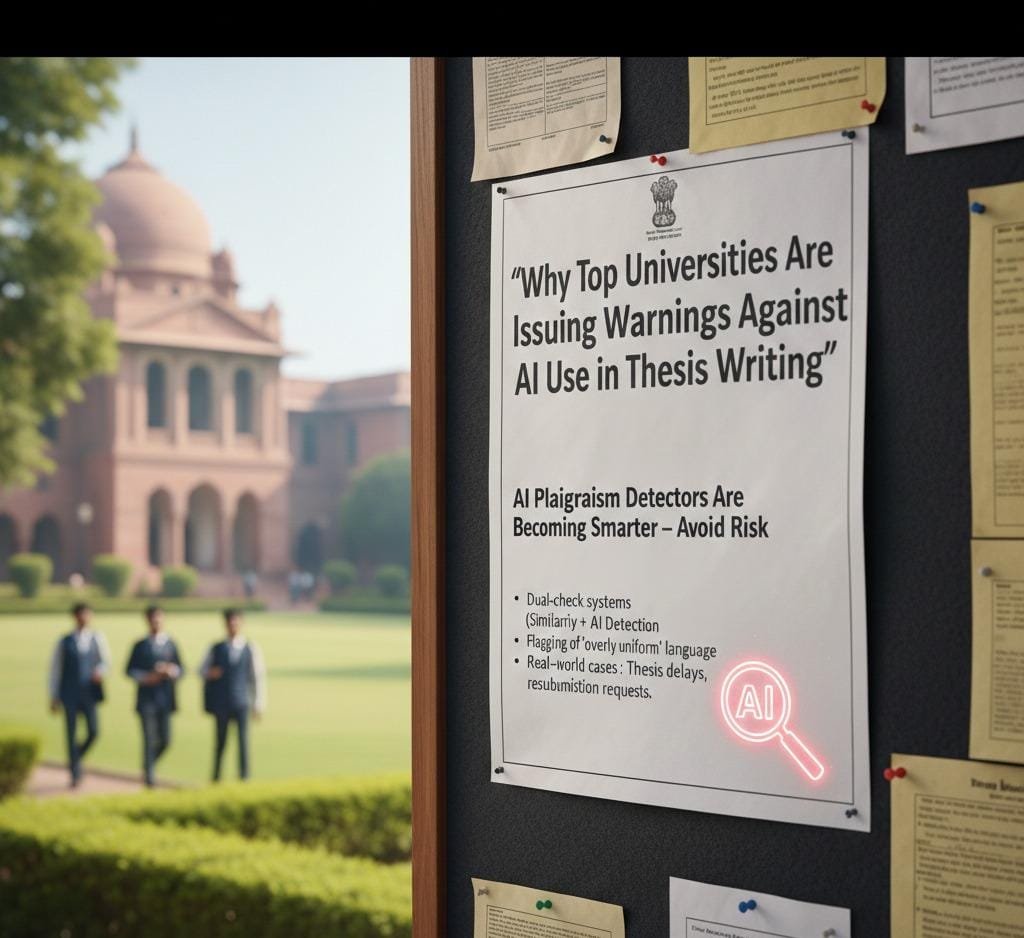
In several institutions, submission now includes both a similarity report and an AI-detection report. This dual check is becoming standard — especially in private universities aiming for international credibility.
Why Universities Are Taking This Seriously
The concern is not just about technology — it’s about trust. A thesis represents years of independent academic labour. When AI is used to generate ideas, conclusions, or paraphrased arguments, it dilutes the value of the research. It also introduces a risk of misinformation, because AI tools often create fictitious citations or misrepresent complex academic positions.
Universities are also aware of the pressure many scholars face — language barriers, lack of supervisor feedback, or time crunch. In this climate, AI offers a seductive shortcut. But top academic institutions are drawing a firm ethical boundary: support is allowed; substitution is not.
There are also legal and reputational concerns. If a university awards a degree based on a thesis later found to be largely AI-written, its academic integrity comes under question. In a globalised academic world where collaboration, funding, and publishing rely on credibility, no serious institution wants to risk that.
Moreover, AI-generated writing often lacks regional specificity. For Indian scholars writing about policy, development, education, or social change, this can be a serious flaw. A thesis on tribal healthcare in Chhattisgarh cannot sound like a report written for a Western audience. And that’s exactly how AI-written content often sounds — general, disconnected, and hollow.
Implications for PhD Scholars in India
For scholars, the message is clear: universities expect you to write your thesis. This doesn’t mean you cannot get help. Academic editing, language review, and citation support are all valid forms of assistance. But the thinking, structuring, interpreting, and articulating must be yours.Several scholars have already faced delays or rejections because of AI-related issues. A PhD student at a prominent university in South India was asked to revise two chapters after the review committee flagged them as “over-processed.” While the similarity report was clean, the AI-detection tool showed high confidence that the content was machine-generated.
The student admitted to using an AI paraphrasing tool, thinking it was harmless. She had to rework those sections — this time, in her own voice.
Another scholar from a private university in Maharashtra shared that her literature review was rejected for being too generic. She had used AI to summarise several papers quickly. But the result lacked synthesis — it listed points, but didn’t show understanding. Her guide advised her to slow down, read deeply, and rewrite the section based on her own interpretations.
These examples are not isolated. They reflect a growing pattern — one that Indian universities are preparing for, not just reactively, but through policy and procedure.
Conclusion
As AI tools become more sophisticated, so do the systems meant to detect their misuse. Top universities in India are not resisting change — they are protecting the essence of research. A thesis must reflect your questions, your interpretations, and your academic growth. AI cannot think for you. And when it does, it compromises the very purpose of a PhD.
For Indian scholars — whether in private universities, working professionals, or regional language backgrounds — support is available. Editors, mentors, and consultants can help refine your work. But the work itself must remain yours.
In the end, a thesis is not just a requirement. It is a mark of your academic honesty. Let it sound like you — not like a machine.