
Introduction
In Indian academia today, especially in private universities, there’s increasing pressure on PhD scholars to submit polished, well-structured theses that match international standards. For many, English is a second language, and juggling academic demands with personal responsibilities leads to the natural urge to seek help. AI writing tools like ChatGPT, GrammarlyGO, or other paraphrasers have emerged as popular aids. They offer neatly written paragraphs, clear transitions, and formal academic language — seemingly perfect for thesis chapters.
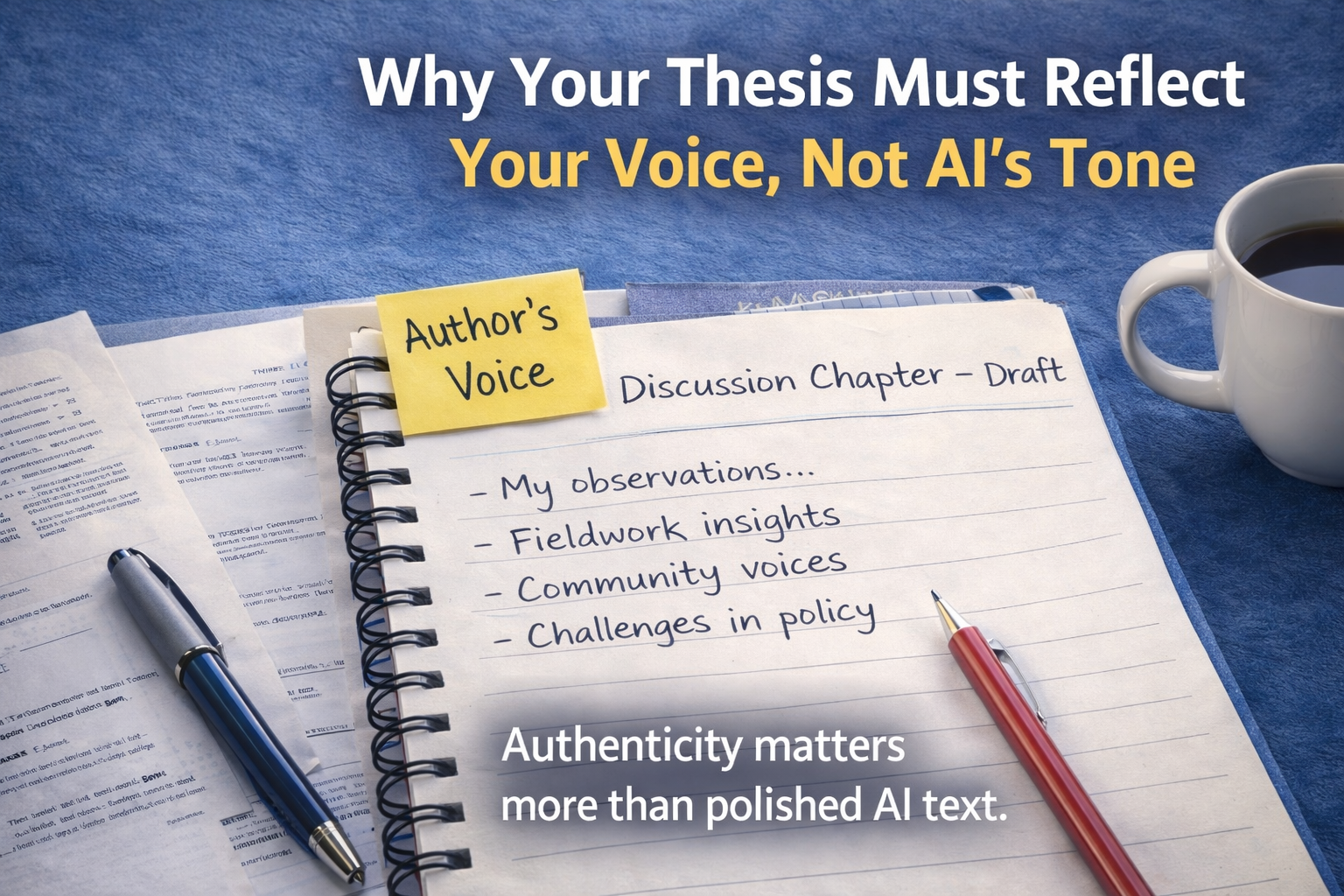
But here’s the problem: when AI writes your thesis, it slowly starts to erase your voice. And in a research culture that values authenticity, originality, and lived insight — especially in Indian fields like education, sociology, policy, or rural development — this can have serious consequences. A thesis is not just about correct grammar or refined structure. It’s about representing what you think, how you observe, and how you interpret — not how an AI rephrases your work.
Why Academic Voice Matters More Than Surface Polishing
In India, many research topics are deeply personal. Whether you’re writing about gender dynamics in Rajasthan, the effectiveness of school programmes in Odisha, or urban waste management in Delhi, your work is tied to real people and contexts. Often, PhD scholars bring personal insight — from fieldwork, language familiarity, or lived experience — into their writing. This academic voice is what makes your thesis meaningful.
When you overuse AI tools to write or rephrase your chapters, you risk replacing your voice with a generic tone. AI-generated language tends to sound globally acceptable but emotionally flat, overly structured, and disconnected from ground realities. For example, an AI tool may convert a powerful observation from your field notes into a sterile academic line — just because it “sounds more formal.”
Reviewers and guides can sense this disconnection. A chapter that suddenly sounds too polished compared to previous drafts raises questions. More importantly, your ability to defend your thesis during the viva depends on how well you own your arguments. If AI has shaped your voice too much, you may struggle to explain how you arrived at certain points or why you phrased things a certain way — because the choices weren’t truly yours.
AI’s Tone vs. Indian Academic Reality
One of the common features of AI-generated academic writing is its preference for neutrality, global vocabulary, and structured logic. While this might be helpful in technical writing, it often clashes with the tone expected in Indian research contexts — especially in social sciences and education-based studies.
Here’s where the mismatch happens:
- Use of Over-Generic Language: AI prefers phrases like “In the contemporary landscape of education,” or “Rapid urbanisation presents multifaceted challenges.” These phrases may sound academic but carry little depth. Indian reviewers expect specific framing — for instance, referring to the role of the Right to Education Act or challenges in district-level governance — not just abstract trends.
- Lack of Cultural Nuance: If you’re discussing caste, language, rurality, or migration, your writing must reflect local realities. AI often erases such detail or replaces it with vague substitutes. Your unique phrasing — perhaps influenced by your mother tongue or field exposure — is a strength, not a weakness. It adds texture to your thesis.
- Mismatch in Academic Style Expectations: In many Indian private universities, supervisors prefer a blend of clarity and personal insight — not just technical correctness. A thesis that reads like a textbook may be grammatically sound but academically unconvincing. AI tools can create this textbook-like tone unless closely supervised.
The Risks of Losing Yourself in the Writing
The goal of a PhD is not just to submit a document. It is to emerge as an independent thinker. Every chapter you write is part of that intellectual journey. When you let AI dictate the tone, you risk interrupting that process. Instead of wrestling with ideas, learning to phrase things your way, and gaining confidence in your scholarly identity, you may end up becoming a passive editor of AI outputs.
Some Indian scholars have faced this directly. A PhD candidate in Bengaluru shared how her discussion chapter was returned with comments like “mechanical writing,” and “lacks personal analysis.” She had used AI to polish it, assuming that smoother meant better. Her supervisor noticed the change in tone — and questioned her involvement. She had to rework the entire section in her own words, eventually earning praise for “depth and voice” in the final version.
AI also tends to overwrite regional expressions, Indian English idioms, or interview nuances that are essential in qualitative research. These small losses, when repeated across chapters, lead to a thesis that feels distant from its subject. For Indian scholars rooted in local issues, that’s a serious loss of authenticity.
Conclusion
Technology is a helpful companion — but not a replacement for your academic self. In the rush to meet deadlines, impress supervisors, or reduce stress, it’s easy to let AI tools overtake your writing process. But your thesis is a record of your thinking, your effort, and your growth as a scholar. If it doesn’t sound like you, then what exactly does it represent?
A strong thesis doesn’t have to sound “perfect.” It has to sound thoughtful, honest, and rooted. Your academic voice — with its rhythms, concerns, and questions — is what gives your work meaning. AI can fix commas. But only you can speak as yourself.
Let the tools assist. But let your voice lead.