
Introduction
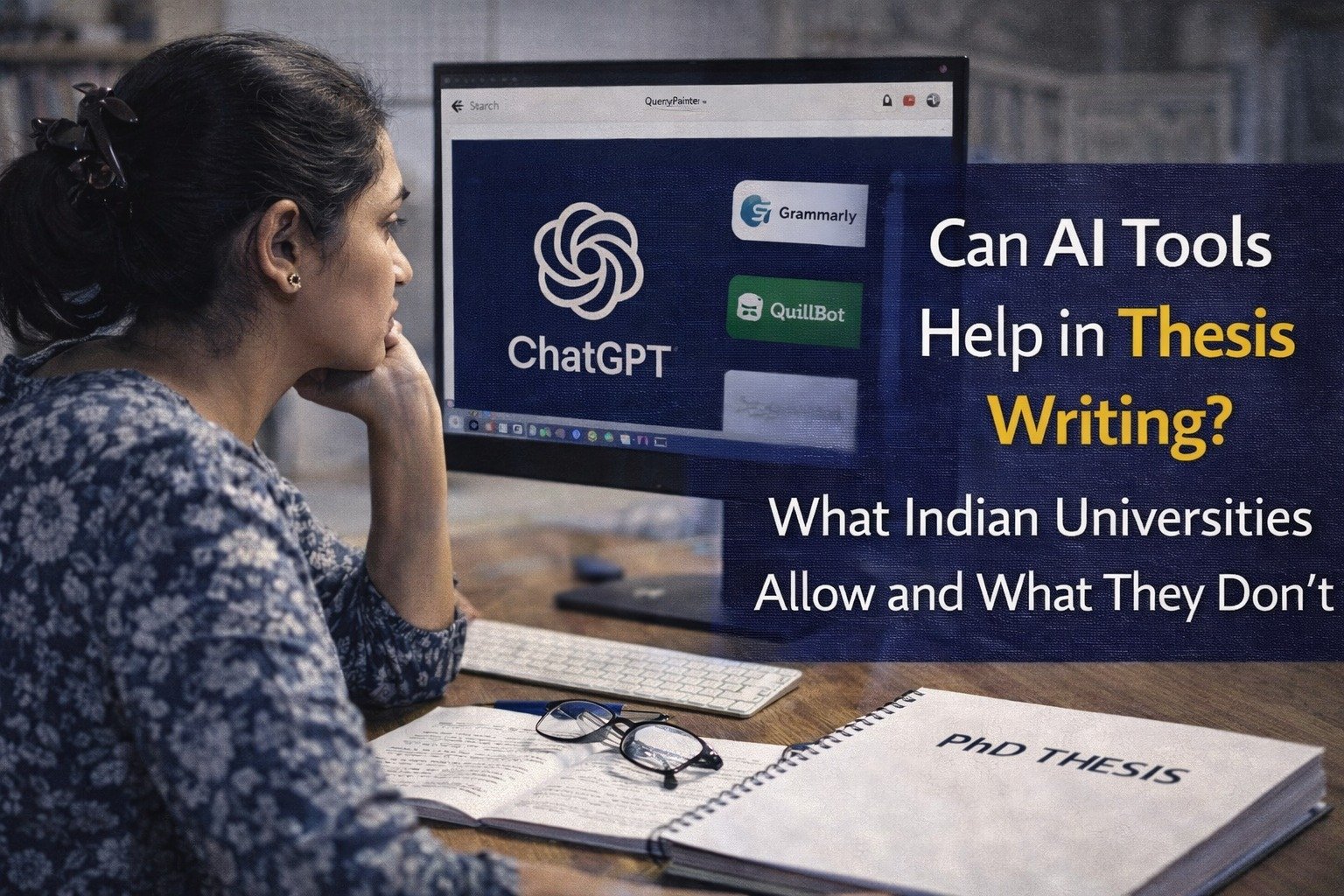
As the academic landscape evolves, many Indian PhD scholars find themselves at a crossroads—wondering if AI tools like ChatGPT, Grammarly, or Quillbot can be part of their thesis writing journey. With tight deadlines, limited supervisor availability, and increasing expectations for polished academic work, the temptation to lean on artificial intelligence is real. Yet, this convenience also brings a critical question: are these tools ethically and academically acceptable in Indian universities?
“Can AI tools help in thesis writing?” is not just a technical question—it’s a cultural and academic one. It sits at the intersection of evolving digital literacy, institutional expectations, and the pressure to deliver. For scholars in private universities especially—where timelines are tighter and support systems more flexible—the issue demands serious thought.
AI Tools: Where They Help, and Where They Mustn’t Replace You
There’s no denying that AI tools have transformed writing processes. For scholars whose first language is not English, tools like Grammarly offer valuable grammar corrections and clarity suggestions. Others use reference managers like Zotero or Mendeley to stay organised with citations. Even ChatGPT, when used mindfully, can help draft outlines, paraphrase ideas, or simplify complex theoretical language for better understanding.
However, the core issue is not whether AI can assist—it’s how and where it’s used. Thesis writing, especially in India, is still regarded as a demonstration of the scholar’s original thought process. Using AI to polish your language or organise your arguments may be fine, but using it to generate full sections of text raises both academic and ethical red flags.
Private universities vary in their stance. Some allow limited AI support—like grammar enhancement or reference formatting—while others strictly discourage the use of any generative tools that may compromise originality. A PhD scholar at a well-known private university in Pune shared how her supervisor encouraged her to use Grammarly for polishing, but warned her not to use AI for content creation. Another from Tamil Nadu said he was asked to attach a self-declaration confirming that no AI-generated content was submitted in his thesis.
There is a fine line between assistance and dependency. A thesis filled with content that wasn’t generated by the scholar—whether by a person or a machine—can’t claim to be an authentic contribution to knowledge. And that’s where the academic concern lies.
What Indian Universities Are Actually Saying
As of now, there is no single national policy on AI use in thesis writing, but the direction is becoming clear. Many Indian universities—especially those affiliated with UGC—are strengthening their policies on academic integrity. AI-generated content is often treated under the broader umbrella of plagiarism or unauthorised assistance.
Private universities, in particular, are adapting faster to the AI conversation. Some institutions have added AI-related clauses in their thesis submission guidelines, requiring students to disclose if AI tools were used and in what capacity. Others are beginning to use AI-detection software alongside plagiarism checkers like Turnitin. While these tools are still evolving, the message is consistent: the scholar must remain the primary author.
Moreover, ethical concerns are growing. When AI tools are used to create literature reviews or methodology sections, the work no longer reflects the scholar’s intellectual effort. This not only affects academic credibility but also undermines the core purpose of doctoral training. A thesis is meant to build a researcher’s ability to think, analyse, and communicate independently—not just to produce a finished document.
Still, not everything is negative. There’s recognition that some AI tools, when used ethically, improve the writing experience. For example, a PhD scholar from Delhi NCR found that using ChatGPT to summarise dense articles helped her engage better with existing research. Another used it to test the readability of his thesis abstract. These are not replacements for thinking—but extensions of it.
What matters is transparency and intention. If a tool is helping you understand better, write clearer, or format correctly—it’s probably safe. But if it’s doing the thinking and writing for you—it’s crossing the line.
Conclusion
AI tools are here to stay, but thesis writing remains a deeply human process. Indian PhD scholars—especially those in flexible or digitally supported environments—will continue to explore ways to work smarter. But with that freedom comes responsibility. A well-written thesis is not just about language fluency or structure—it’s about intellectual ownership.
As you navigate this new terrain, the real question to ask is not “Can I use AI?” but “Am I still the author of this work?” If the answer is yes, and you’re clear about how and where you’ve used assistance, then you’re likely on safe ground.
Technology can support your journey, but it cannot walk it for you. Your thesis, ultimately, must remain your voice—refined perhaps, but never replaced.