Introduction
With the easy accessibility of online content, plagiarism detection has become a core responsibility in academic research. In India, many supervisors and students still rely on a simple Google search to check if a sentence or paragraph appears elsewhere on the internet. While this approach seems quick and free, the question remains—can Google Search truly replace a dedicated plagiarism detection tool? For PhD scholars, especially in private universities, where maintaining academic integrity is crucial for thesis approval, the answer requires careful consideration.
Why Google Search Appears Attractive
The most obvious benefit of Google Search is that it is free, fast, and easy to use. Students can simply copy a sentence from their thesis, paste it into the search bar in quotation marks, and instantly find if an identical phrase appears online. This method requires no training, no subscription, and no installation of software. For resource-limited institutions, this is often seen as a practical shortcut.
The Core Limitations of Google Search
Despite its simplicity, Google Search has significant limitations as a plagiarism detection method:
- Surface-Level Matching Only – Google primarily matches exact wording. If a sentence is paraphrased or slightly restructured, it may not be detected.
- No Access to Academic Databases – Most scholarly content in journals, conference proceedings, and dissertations is not indexed publicly by Google. This means large portions of plagiarism can go unnoticed.
- No Similarity Percentage – Unlike plagiarism tools that provide a similarity score, Google Search only shows possible matches without quantifying the extent of overlap.
- Manual Checking Is Time-Consuming – Every sentence or paragraph must be checked separately, which is impractical for lengthy PhD theses.
Why Professional Plagiarism Tools Outperform Google Search
Dedicated plagiarism detection software like Turnitin, Urkund, and Grammarly’s plagiarism checker compare documents against extensive academic databases, subscription-based content, and archived research. They use advanced algorithms to detect paraphrased content, synonym replacement, and even certain forms of translation-based plagiarism—capabilities Google lacks. For PhD scholars in India, where UGC guidelines require a similarity report from approved software, relying solely on Google Search may lead to non-compliance.
When Google Search Can Still Be Useful
While it should not replace professional plagiarism tools, Google Search can be a helpful supplementary method:
- Quick Checks for Common Phrases – Especially in literature review drafts, to see if exact sentences appear online.
- Checking Unpublished Sources – For detecting plagiarism from blogs, online magazines, or personal websites not included in academic databases.
- Spot-Verification – If a similarity report flags certain content, Google can help confirm whether the source is publicly accessible.
The Indian Academic Context
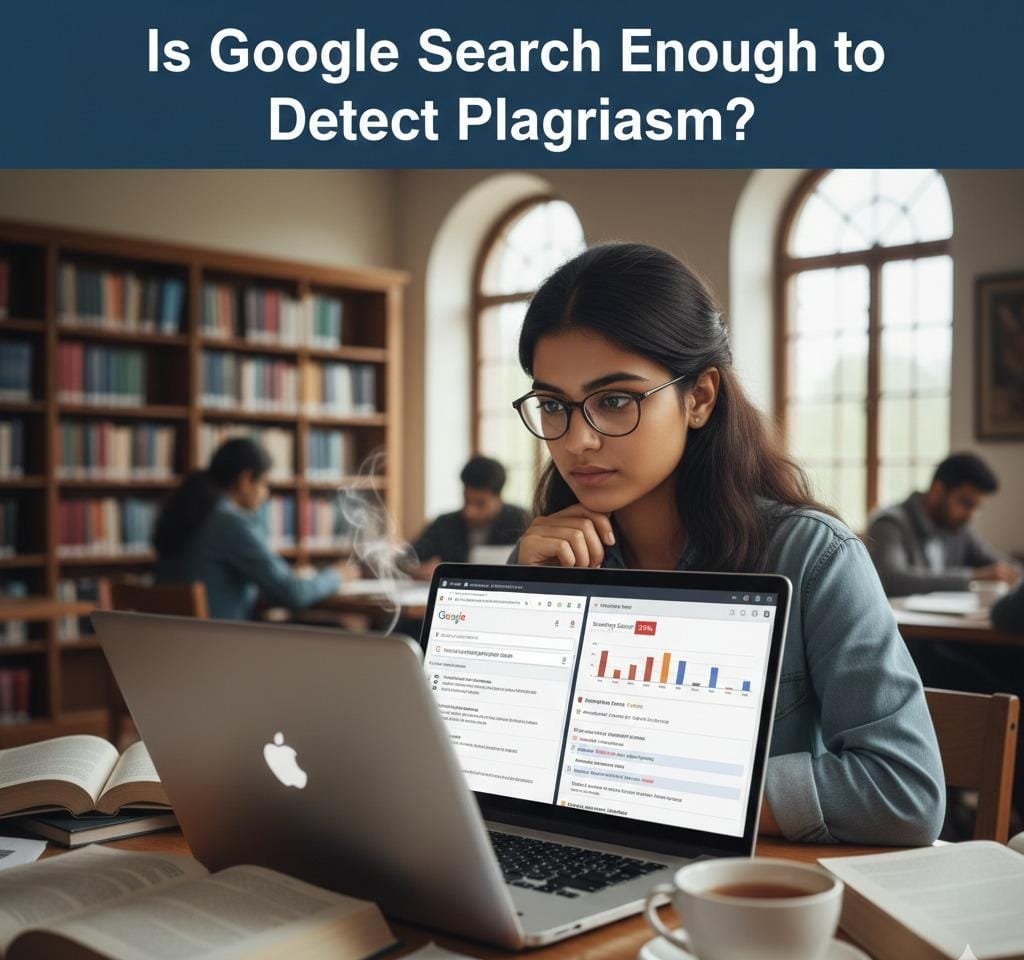
In India, private universities often have access to institutional plagiarism checkers, but students sometimes still try to “self-check” using Google before submitting their drafts. This can give a false sense of security. A Google Search might show zero results for a paraphrased paragraph, yet Turnitin may flag it as 25% similar due to matches in restricted academic repositories. Therefore, Indian PhD students must understand that Google is not an alternative but a supplementary step.
Conclusion
While Google Search offers a free and quick way to identify exact content matches, it is not comprehensive enough to ensure plagiarism-free academic work. For a PhD thesis, especially in Indian private universities where UGC guidelines apply, relying on Google alone risks overlooking hidden overlaps. The best approach is to use institution-approved plagiarism detection tools and, where necessary, use Google Search as an additional, informal verification step. Academic integrity demands more than surface-level checks—it requires thorough, database-backed verification to protect originality and credibility.