
Introduction
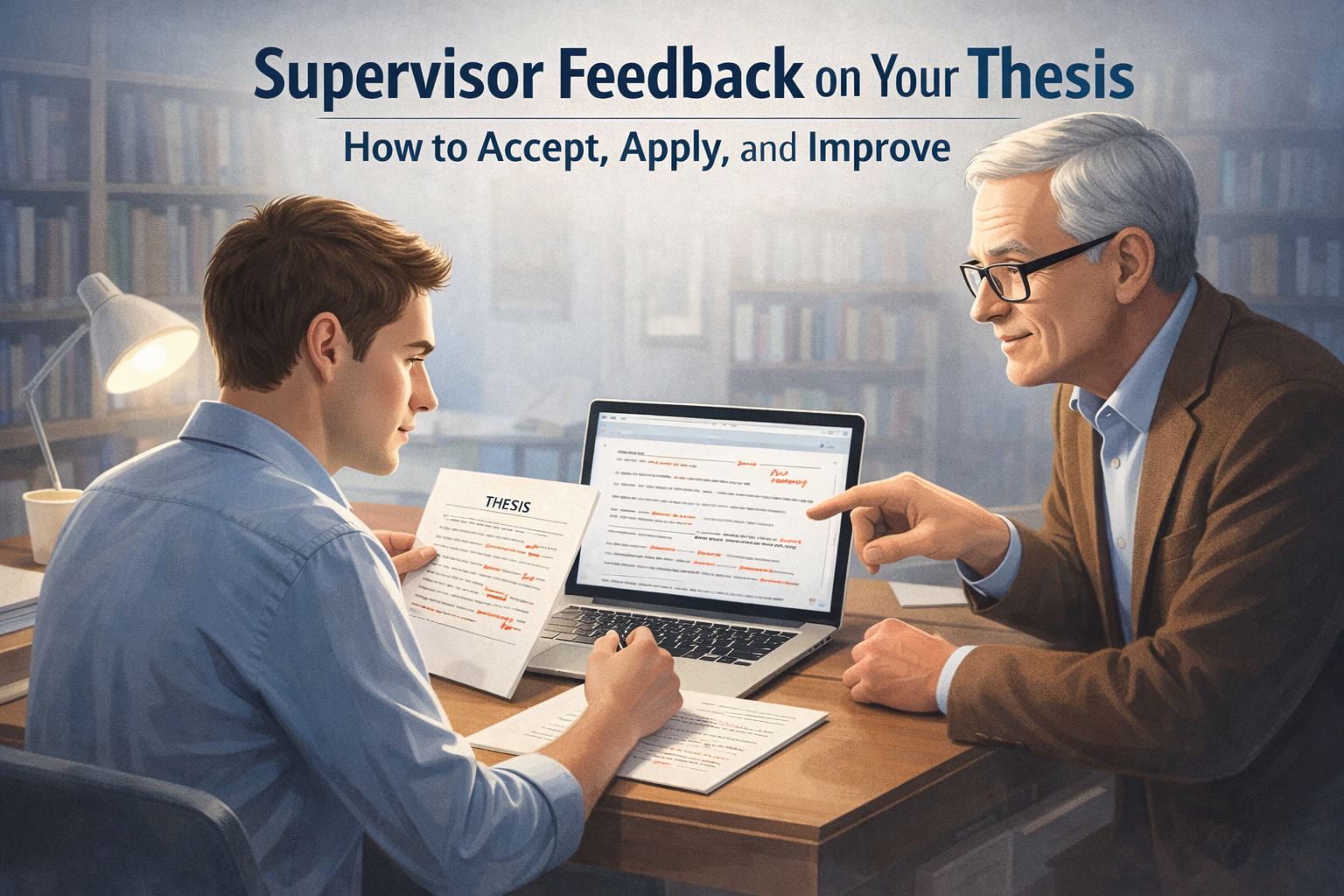
Receiving feedback on your thesis draft is one of the most emotionally charged moments in a PhD journey. For many Indian scholars, especially those studying at private universities or returning to academics after years of professional work, supervisor comments can feel confusing, overwhelming, or even discouraging. It’s not uncommon to see remarks like “needs clarity,” “restructure this section,” or “too descriptive” written in the margins—but what do they really mean? More importantly, how should one respond?
In the context of doctoral research, supervisor feedback on your thesis is not a verdict—it’s a developmental tool. The way you interpret and apply that feedback can shape the quality of your thesis and your growth as a researcher. Learning how to accept, apply, and improve through feedback is a vital skill that isn’t always taught in Indian academia, but must be cultivated along the way.
Why Feedback Often Feels Harsh—but Isn’t
In Indian academic culture, students often expect a hierarchical, respectful tone from teachers. But thesis supervisors, especially those trained in global academic practices, may be more direct. Their feedback isn’t meant to offend; it’s meant to improve the academic standard of your work. Still, many scholars take it personally—especially when they’ve invested weeks in a chapter that comes back covered in red marks.
This gap in expectation is common in private universities, where supervisors may be juggling multiple scholars and have limited time for detailed hand-holding. A single-word comment like “Expand” may seem vague, but it’s up to the scholar to decode its academic intention: Does it mean include more theory? More data? More explanation?
The key is not to react defensively. Most PhD candidates in India come with a strong emotional investment in their work—sometimes seeing feedback as criticism of their effort rather than guidance for improvement. But feedback is part of the academic process. It is not a rejection; it is a revision map.
How to Apply Feedback Without Getting Lost
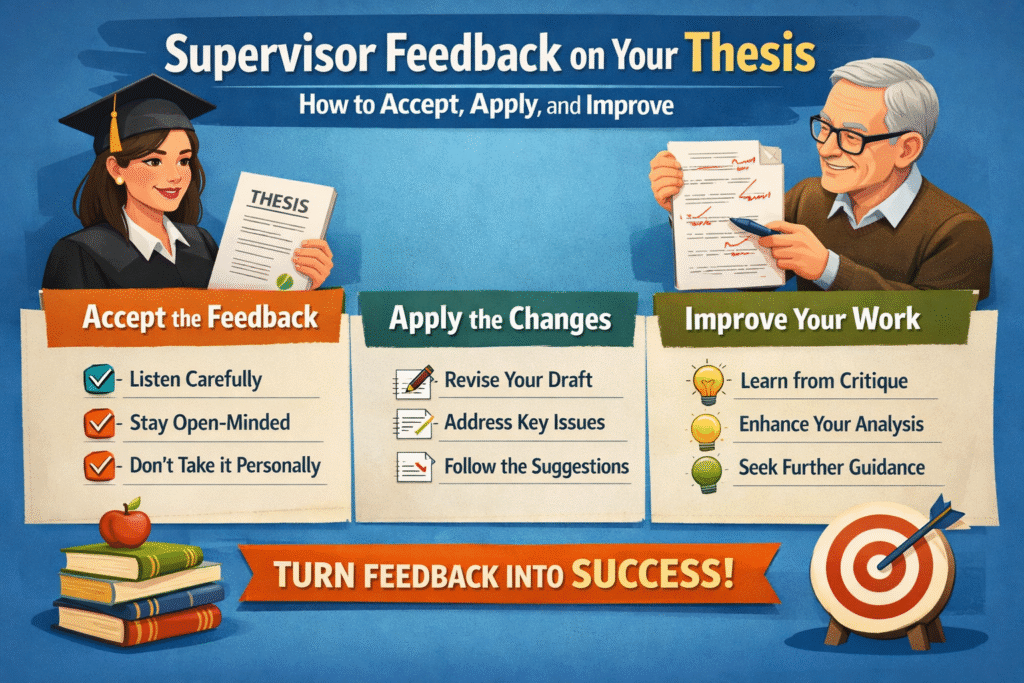
Once you’ve received supervisor comments, the first step is to read them with a calm, open mind. Don’t rush to fix everything in a single sitting. Instead, categorise the feedback. What is structural (like rearranging sections)? What is stylistic (such as tone, clarity, or word choice)? What is content-related (missing references, weak argumentation)?
Next, clarify anything that confuses you. In Indian universities, scholars often hesitate to ask questions, fearing they’ll seem underprepared. But clarifying doubts isn’t a weakness—it’s professionalism. A simple email or meeting to ask, “When you mentioned this section needs more depth, were you referring to theory or findings?” can prevent days of misguided rewriting.
Also, understand that applying feedback doesn’t always mean following every suggestion blindly. If you genuinely believe a section is academically valid as written, you can explain your reasoning—respectfully. Scholarly dialogue is encouraged at the doctoral level. But that also means being able to justify your decisions with evidence and clarity.
Revision should be done in layers. Don’t try to fix every point in one go. Focus on major structural issues first—such as improving your literature framework or reordering chapters—before moving to language, formatting, or transitions.
Improving Through Feedback: A Skill You Build Over Time
Learning from feedback is a process that sharpens your academic maturity. Indian scholars who treat it as a checklist often miss the deeper value: discovering your own writing patterns, blind spots, and assumptions. Over time, you begin to anticipate feedback before it arrives. You catch weak arguments yourself. You start thinking like a reviewer, not just a writer.
Some supervisors are brief in their comments; others may give long written notes. Either way, keep track of recurring patterns. If your supervisor mentions “vague argument” in three places, that’s a signal to work on your conceptual clarity. If “citation missing” shows up often, revisit your referencing habits.
In private university setups, where supervisor time may be limited, self-discipline becomes even more important. Build a habit of re-reading your own work with a critical lens before submission. Use tools—academic writing guides, peer support, or previous thesis examples—to spot issues proactively. This reduces back-and-forth and shows your supervisor that you value their time and feedback.
And remember, improvement is not about eliminating all comments in the next draft. Even final submissions receive feedback. The goal is to evolve with each version—to become a more precise, thoughtful researcher who engages with critique intelligently.
Conclusion
Navigating thesis feedback is one of the most important milestones in a scholar’s academic journey. It tests not just your research but your emotional maturity, patience, and commitment to growth. For Indian PhD students—many of whom carry cultural expectations of academic praise—learning to view feedback as an ally, not an enemy, can be a transformative shift.
The feedback loop is where a good draft becomes a strong thesis. It’s where writing becomes scholarship. And it’s where scholars begin to trust not just their supervisors, but their own evolving academic voice.